Very well. As a quantitative trading researcher proficient in the Wyckoff Method, I will compose a comprehensive and in-depth quantitative analysis report based on the XRPUSDT data and historical ranking metrics you provided.
XRPUSDT Quantitative Analysis Report (Based on the Wyckoff Method)
Product Code: XRPUSDT
Analysis Period: 2026-02-18 to 2026-04-19
Report Generation Date: 2026-04-20
1. Trend Analysis and Market Phase Identification
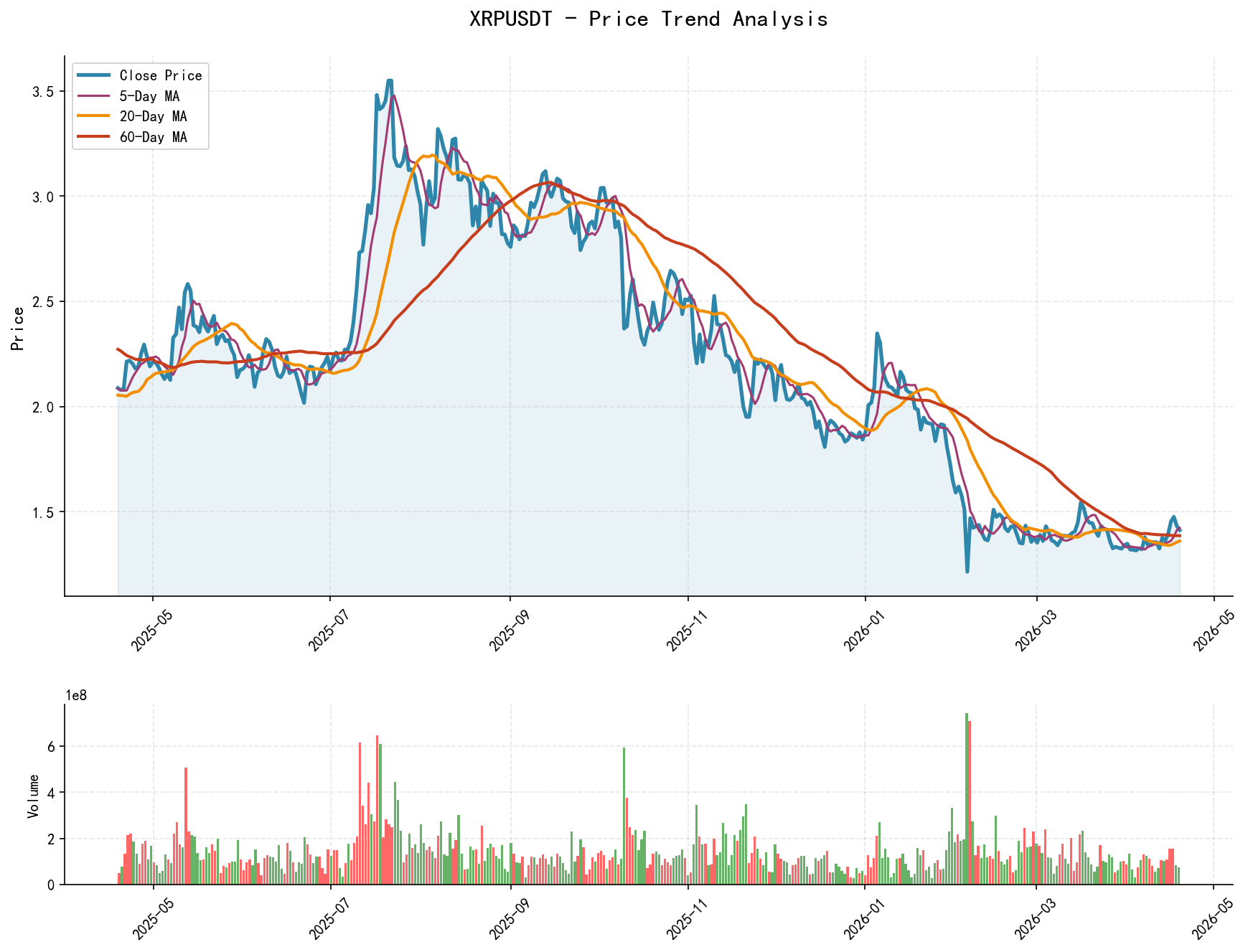
As of 2026-04-19, the underlying XRPUSDT had an open price of 1.43, a close price of 1.41, a 5-day moving average of 1.42, a 10-day moving average of 1.39, a 20-day moving average of 1.36, a daily change of -1.38%, a weekly change of 6.63%, a monthly change of 5.32%, a quarterly change of 5.32%, and an annual change of -23.33%.
Data-Driven Objective Analysis:
- • Primary Trend (Bearish Dominance): From the beginning of the analysis period to the present, the closing price (CLOSE) has consistently remained below the MA_60D (1.386~1.822). Furthermore, all long-term moving averages (MA_30D, MA_20D) are in a bearish alignment, confirming the market is in a primary downtrend.
- • Intermediate-Term Oscillation and Rally: On March 16, a strong price rally (+6.51%) occurred, briefly pushing the price above all short-to-medium-term moving averages (MA_5D, MA_10D, MA_20D), but it failed to hold above them sustainably. The rally high of 1.5430 became a subsequent key resistance level. Following this rally, the MA_5D and MA_20D formed a "Death Cross" (around March 20), and the price fell back below the cluster of short-term moving averages, indicating rally failure and the resumption of the bearish trend.
- • Recent Market Structure: Entering April, the price has oscillated narrowly around the MA_5D and MA_10D, showing a lack of clear direction. The MA_5D, MA_10D, and MA_20D are highly converged, indicating the market is in a state of short-term equilibrium.
- • Wyckoff Phase Inference: The high-volume rally in mid-March can be viewed as a "Secondary Rally" or a "Sign of Strength (SOS)". However, the subsequent low-volume decline and the death cross suggest this signal was not confirmed. Currently, the price has returned near the starting point of the rally (around 1.41). The market is likely at the lower boundary of a "Reaccumulation" or "Distribution" range within the primary downtrend. Subsequent price and volume action is needed to confirm whether a new base is being built or if this is a continuation pattern before further decline.
2. Price-Volume Relationship and Supply-Demand Dynamics
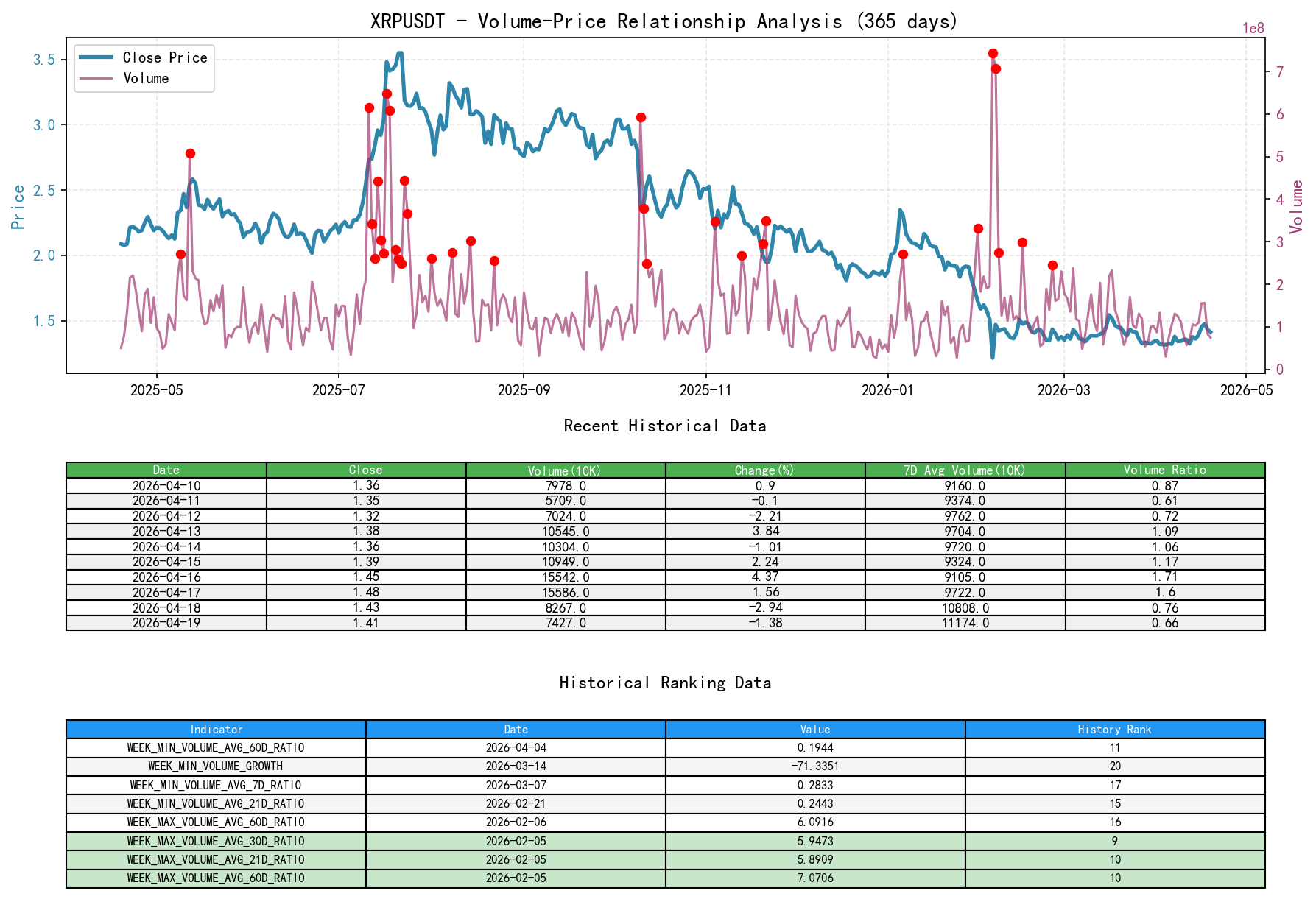
As of 2026-04-19, the underlying XRPUSDT had an open price of 1.43, a close price of 1.41, a volume of 74273456.90, a daily change of -1.38%, a volume of 74273456.90, a 7-day average volume of 111742441.20, and a 7-day volume ratio of 0.66.
Data-Driven Objective Analysis:
- • Key Bullish Price-Volume Signal (March 16): The price rose 6.51% on that day, with volume (218.6M) being 1.40 times the 60-day average volume (156.1M) (VOLUME_AVG_60D_RATIO=1.4005). This is a classic "volume expansion on an advance" (Demand in Control), indicating strong demand entering the market, successfully breaking through short-term resistance. The TB_BASE_VOLUME (real buying pressure) accounted for 51% of the total volume, showing active large buy orders.
- • Key Bearish Price-Volume Signal (April 18): The price fell 2.94% on that day, with volume (82.7M) being only 0.69 times the 60-day average volume (119.5M) (VOLUME_AVG_60D_RATIO=0.6917). This is a "low-volume decline" (Lack of Selling Pressure), suggesting supply did not expand with the price drop, and selling pressure may be nearing exhaustion.
- • Extreme Volume Contraction (Historically Low Levels): According to historical ranking data, the VOLUME_AVG_60D_RATIO on 2026-04-04 (0.1944) ranks as the 11th lowest in the past decade, and the VOLUME_AVG_7D_RATIO on 2026-03-07 (0.2833) ranks as the 17th lowest in the past decade. Such extreme volume contraction typically appears near the end of a trend or at significant turning points, reflecting extreme hesitation among market participants and a temporary balance between bullish and bearish forces—a potential "Lull".
- • Supply Test: On down days such as March 21, 27, and April 2, volume was at or below average levels, with no high-volume panic selling, indicating that downward supply did not continue to expand.
3. Volatility and Market Sentiment
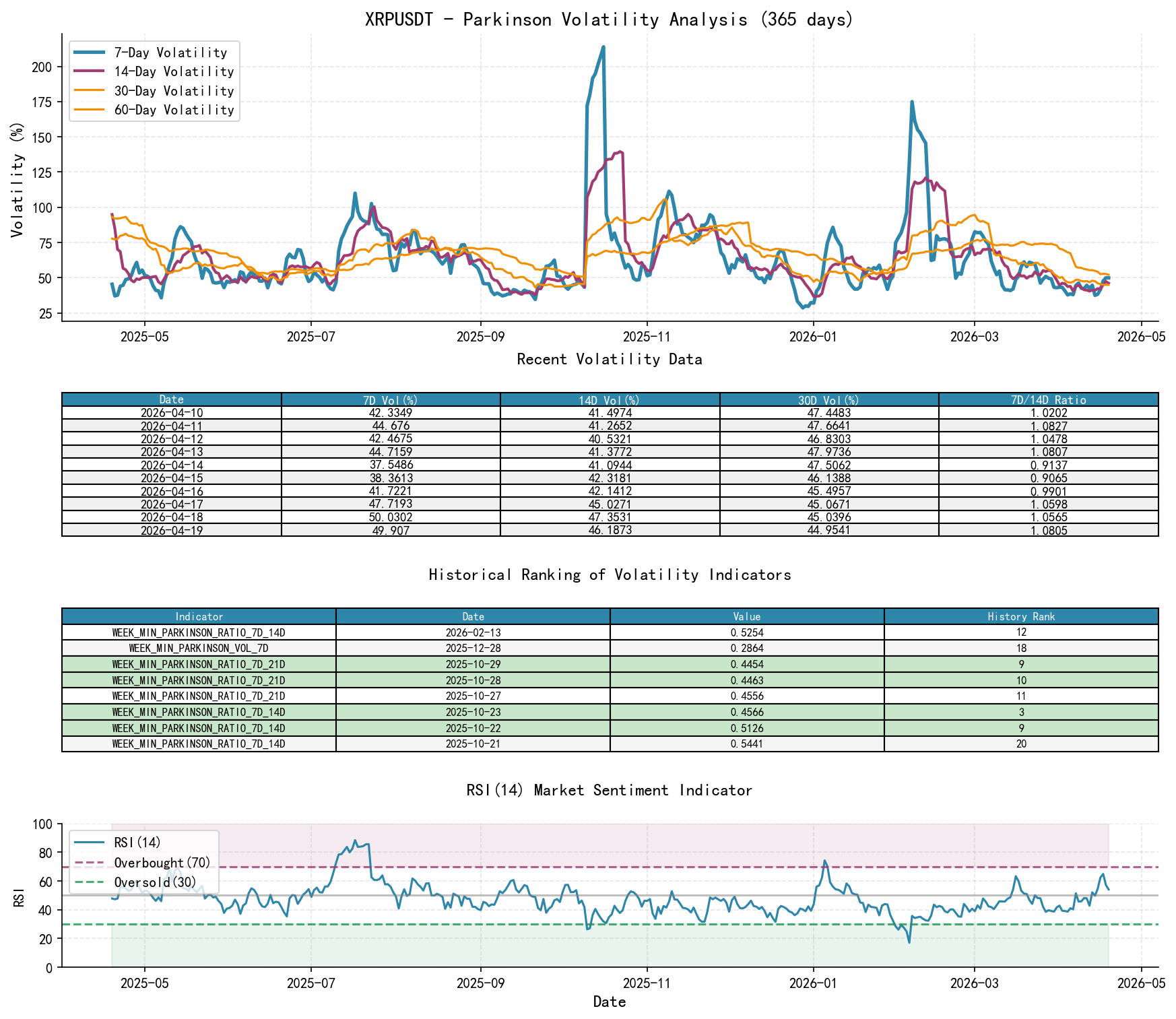
As of 2026-04-19, the underlying XRPUSDT had an open price of 1.43, a 7-day intraday Parkinson volatility of 0.50, a 7-day intraday volatility ratio of 1.08, a 7-day historical volatility of 0.53, a 7-day historical volatility ratio of 1.11, and an RSI of 54.12.
Data-Driven Objective Analysis:
- • Volatility Structure: The short-term historical volatility (HIS_VOLA_7D) decreased from 0.565 to 0.528 between March 7 and April 19, showing a converging trend. Simultaneously, its ratio relative to long-term volatility (HIS_VOLA_RATIO_7D_60D) remained below 1, indicating short-term volatility is not deviating from the long-term framework, and market sentiment is not at extreme panic levels.
- • Intraday Volatility: The Parkinson volatility (PARKINSON_VOL_7D) reached a recent high of 0.5003 on April 18, showing larger price swings that day. However, its ratio to the long-term average (PARKINSON_RATIO_7D_60D=0.9487) did not deviate significantly from 1, remaining within a normal volatility range.
- • Sentiment Indicators: The RSI_14 oscillated between 35 and 65 throughout the cycle, never reaching extreme overbought (>80) or oversold (<20) levels. The RSI at the March 16 rally high was 63.37, not reaching overbought; recent lows had RSI in the 38-42 range, approaching but not reaching oversold. This indicates market sentiment is neutral-to-weak but not extremely pessimistic, lacking the emotional foundation for panic selling.
4. Relative Strength and Momentum Performance
Data-Driven Objective Analysis:
- • Short-Term Momentum (Positive but Weakening): The WTD_RETURN (weekly return) was +6.63% on April 19, primarily driven by gains from April 13-16. However, the last three days (April 17-19) closed lower consecutively, indicating short-term upward momentum has decayed.
- • Medium-Term Momentum (Weak): The MTD_RETURN (monthly return) is +5.32%, and the QTD_RETURN (quarterly return) is +5.32%, both showing the rebound since April has not fully recovered the losses from late March. Looking longer-term, the YTD (year-to-date) return is -23.33%, and the TTM_12 (trailing 12-month) return is -32.34%, confirming the underlying asset is in a medium-to-long-term weak pattern.
- • Conclusion: Momentum performance reflects the contradiction of "short-term corrective rally vs. long-term downtrend." Recent positive returns are built upon a substantial long-term negative return foundation. The sustainability and magnitude of the rally are questionable; the momentum structure does not support an immediate shift to a trending bull market.
5. Large Investor ("Smart Money") Behavior Identification
Inference based on price-volume and volatility data:
- • High-Volume Activity on March 16: Smart money likely dominated the high-volume breakout that day. Two possible intents:
- 1. Active Accumulation / Initiating a New Trend: Attempting to attack a key resistance level (previous high).
- 2. Rally Distribution (Bearish): Using the rally to distribute previously accumulated positions to retail traders chasing the highs. Given the price failed to hold and was followed by low-volume declines, the second possibility (distribution) currently appears more likely. Smart money may have taken advantage of market optimism to reduce positions.
- • Low-Volume Behavior in April: Extremely low volume occurred on dates like April 4 and April 11. According to historical rankings, the degree of volume contraction on April 4 is rare for the past decade. This typically indicates:
- 1. Large Investors Have Stopped Selling: Smart supply is no longer willing to sell at current levels.
- 2. Market Lacks Directional Guidance: Smart money is观望, waiting for clearer fundamental or market signals.
- • Comprehensive Assessment: Smart money exhibited "distribution" characteristics at the March rally highs and shows signs of "stopped selling" and "观望" at the current low-price region. There are no observed signs of panic selling or large-scale active accumulation. The market is in a "testing period of supply-demand balance."
6. Support/Resistance Level Analysis and Trading Signals
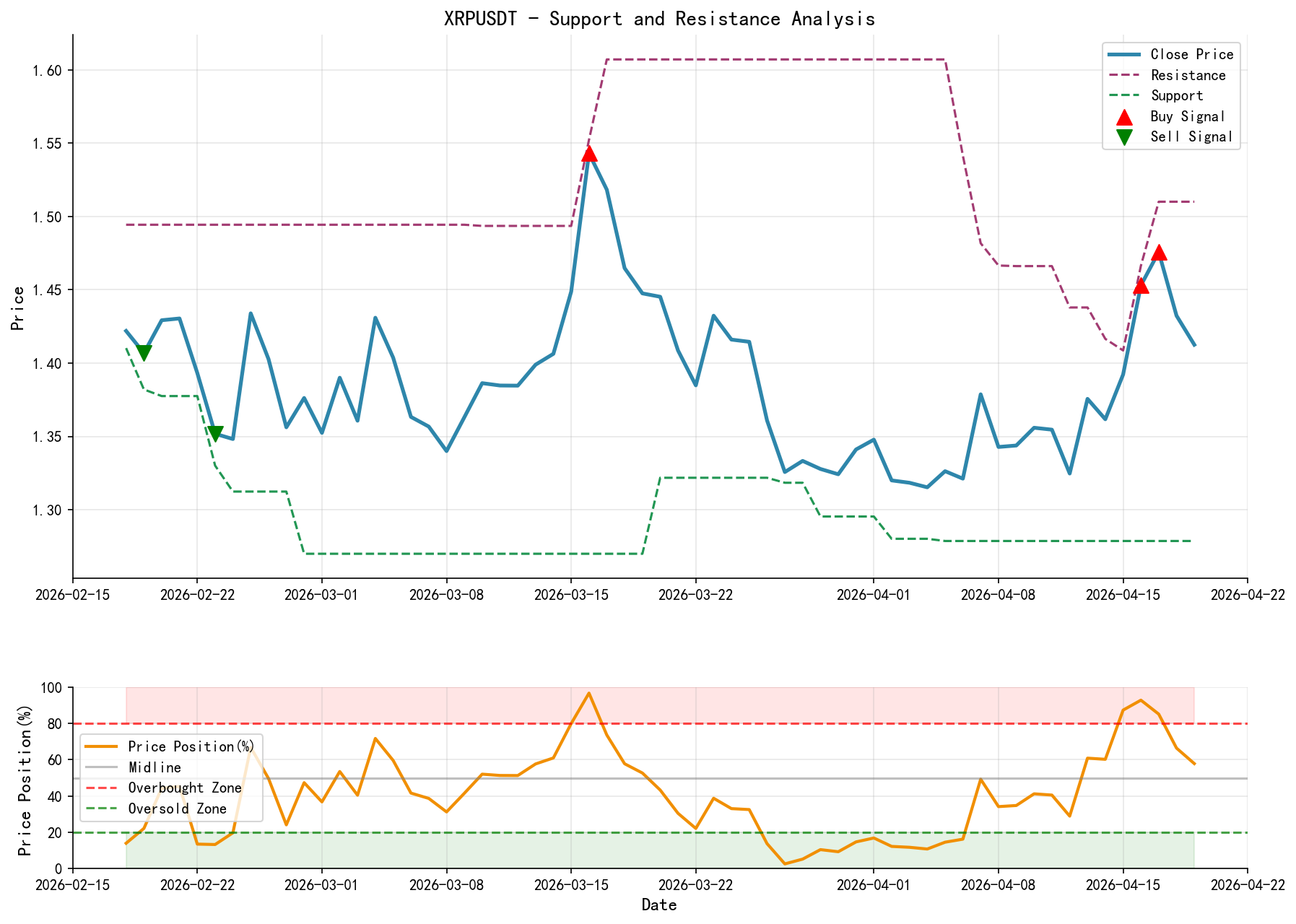
Key Level Identification:
- • Primary Resistance (R1): 1.5430 (March 16 rally high). A break above this level could potentially reverse the intermediate-term downtrend.
- • Secondary Resistance (R2): 1.4320 - 1.4480 (April 15-16 highs, also the upper boundary of the recent consolidation range).
- • Primary Support (S1): 1.3250 - 1.3330 (The low area tested multiple times from March 28 to April 1, also the starting point of the March rally).
- • Secondary Support (S2): 1.2700 (February 28 low).
Comprehensive Wyckoff Trading Signals and Action Plan:
Current Signal: Observe / Wait for Clearer Signals, Leaning Towards Seeking Buying Opportunities at Support Levels.
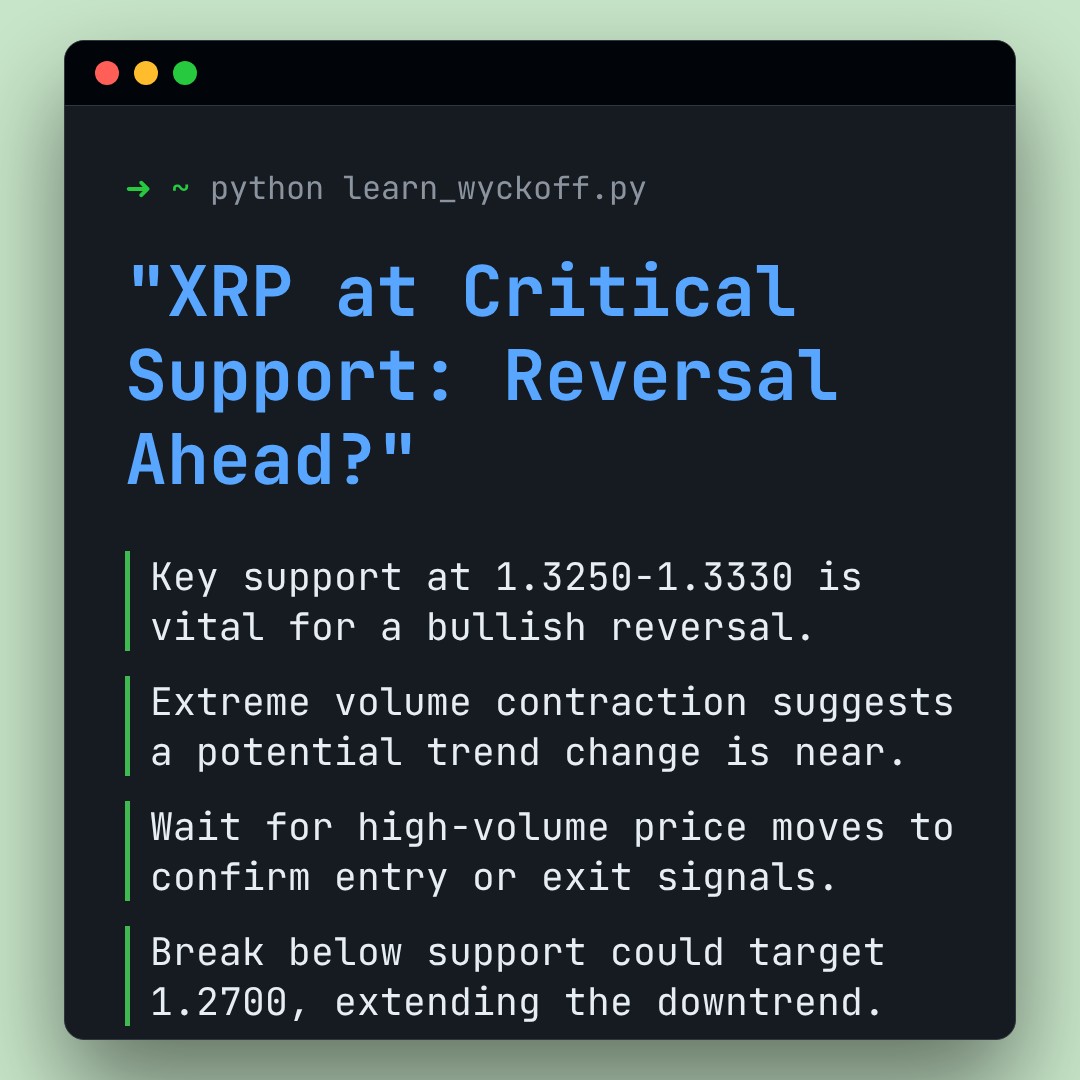
- 1. Market State: The market is in a low-level consolidation phase following a prolonged downtrend. Smart money has stopped selling, but demand has not entered the market on a large scale. Volume contraction to historically extreme levels suggests a potential trend change may be approaching.
- 2. Bullish Scenario Validation Point:
- • Event: Price finds support in the S1 (1.325-1.333) area and exhibits a "high-volume advance" on the daily chart (e.g., volume > 1.3 times the 60-day average, price gain > 3%).
- • Signal: Confirms demand entering at a key support level, which can be viewed as a Wyckoff bullish event like a "Spring" or "Jump across the Creek".
- • Action Plan (Aggressive): If the above validation point occurs, consider a light long position trial, with an initial stop-loss set below the S1 area (e.g., 1.310).
- 3. Bearish Scenario Validation Point:
- • Event: Price rallies to the R2 (1.432-1.448) area or higher and shows "high-volume churning/stopping" or a "high-volume decline".
- • Signal: Confirms supply reappearing at resistance, constituting an "Upthrust" or "Sign of Weakness (SOW)".
- • Action Plan: If the above validation point occurs, it can be considered a signal for adding to short positions or the end of the rally, with a stop-loss set above R1 (1.543).
- 4. Core Risks and Future Monitoring Points:
- • Risk: If the price breaks below S1 support accompanied by expanding volume, it may initiate a new wave of the downtrend, targeting S2.
- • Monitoring Point: Continuously monitor volume changes. Significant volume expansion in either direction (up or down) will be key to discerning smart money intent and determining the next phase trend.
Summary: XRPUSDT is currently at a critical supply-demand equilibrium point. Extremely low volume (historically low levels) and the absence of panic selling provide a foundation for potential bottom formation. However, demand must prove its strength through "high-volume advances" and effectively break through recent resistance. Traders should maintain patience, waiting for the market to provide a directional choice through clear price-volume action.
(End of Report)
Disclaimer: This report/analysis is solely market analysis and research based on publicly available information and does not constitute any investment advice or operational guidance. The author strives for objectivity and impartiality but makes no guarantees regarding the accuracy or completeness of the content. Markets involve risks, investments require caution. Any investment actions based on this report are undertaken at your own risk.
Thank you for your attention! Wyckoff price-volume market analysis is published daily at 8:00 AM before the market opens. We appreciate your comments and shares; your recognition is crucial. Let's work together to see the market signals clearly.
Member discussion: