
Okay, I will act as a quantitative trading researcher proficient in the Wyckoff Method. Based on the POLUSDT data and historical ranking indicators you provided, I will write a comprehensive and in-depth quantitative analysis report for you.
POLUSDT Quantitative Analysis Report (Based on the Wyckoff Method)
Product Code: POLUSDT
Analysis Date Range: 2026-02-18 to 2026-04-19
Report Generation Date: 2026-04-20
1. Trend Analysis & Market Phase Identification
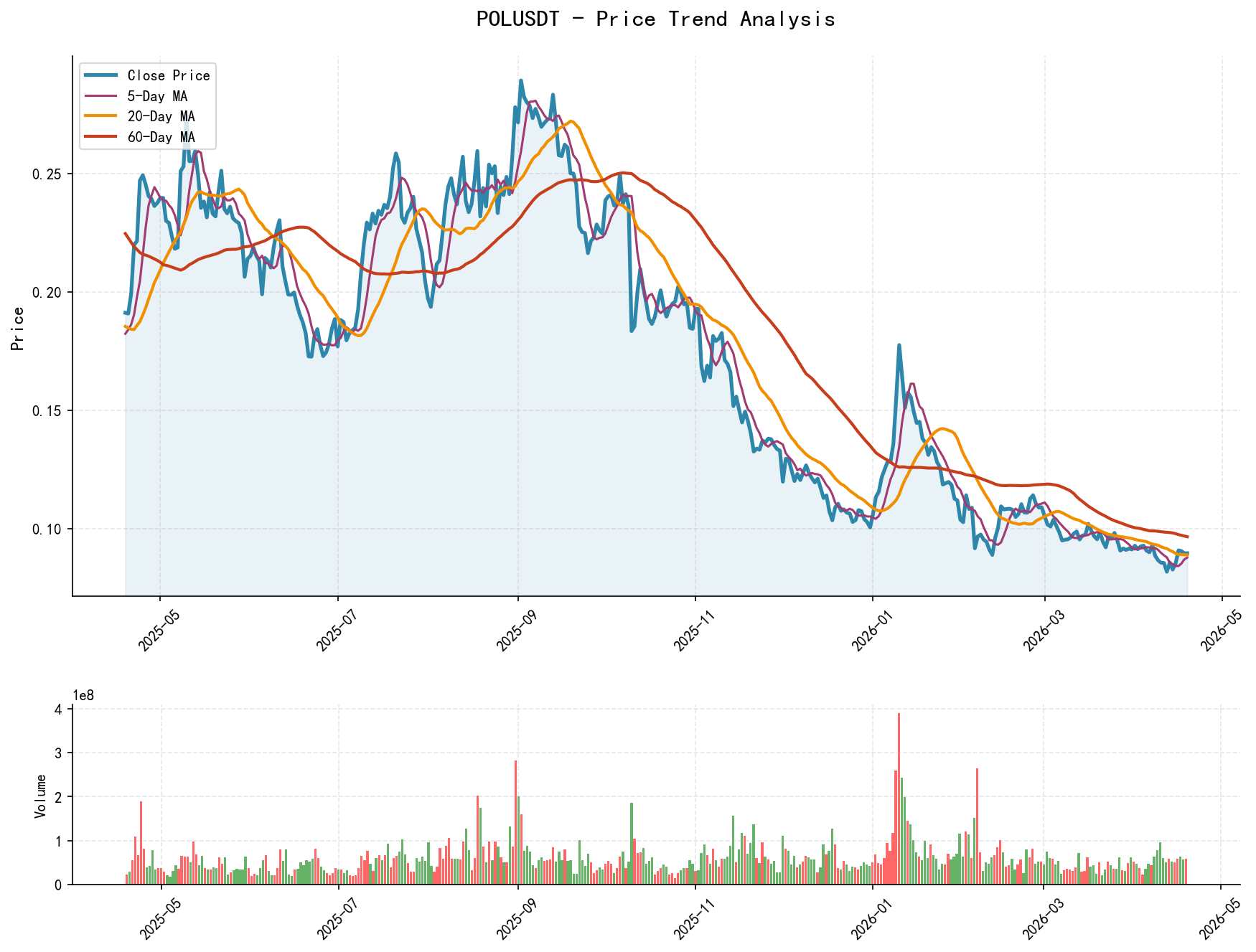
As of April 19, 2026, for the asset POLUSDT: Opening Price 0.09, Closing Price 0.09, 5-Day Moving Average (MA) 0.09, 10-Day MA 0.09, 20-Day MA 0.09, Daily Change 0.00%, Weekly Change +9.54%, Monthly Change -1.75%, Quarterly Change -1.75%, Annual Change -10.85%.
Data Observations:
- • Long-term Trend (Bear Market): The price has been consistently trading below the 60-day MA (MA_60D: ~0.0986), with the sequence MA_60D > MA_30D > MA_20D > current price forming a classic bearish alignment. Long-term return data such as TTM_12 (-53.11%) confirms the long-term downtrend.
- • Mid-term Trend (Bottoming/Consolidation): After falling from the high of 0.1141 in early March to the low of 0.0818 in mid-April, the price has been consolidating widely within the 0.082-0.092 range. A key change is that the 20-day and 30-day MAs have flattened and begun to converge, while the short-term 5-day and 10-day MAs (MA_5D: 0.0878, MA_10D: 0.0864) are intertwined, indicating a slowdown in mid-term downward momentum.
- • MA Crossover Signal: Currently, MA_5D (0.0878) has crossed above MA_10D (0.0864), but MA_10D remains below both MA_20D (0.0889) and MA_30D (0.0908). Looking at the dynamic of crossovers, since the high-volume surge on April 16th, the short-term MA system shows signs of forming a "Golden Cross" and attempting to cross above the mid-term MAs. However, this has not yet succeeded, indicating it is in the early stages of an attempted reversal.
- • Wyckoff Phase Inference: Based on price action and volume-price relationships (detailed below), the market transitioned from the Distribution Phase in late February to early March, experienced a Panic Decline and Automatic Rally from March to early April, and may currently be in the early stages of a "Secondary Test" or "Accumulation" phase. Price is oscillating repeatedly in a historically low area (historical rankings show prices near ten-year lows multiple times in April), with volume contracting during declines and expanding moderately during rallies, consistent with characteristics of an Accumulation phase.
2. Volume-Price Relationship & Supply-Demand Dynamics
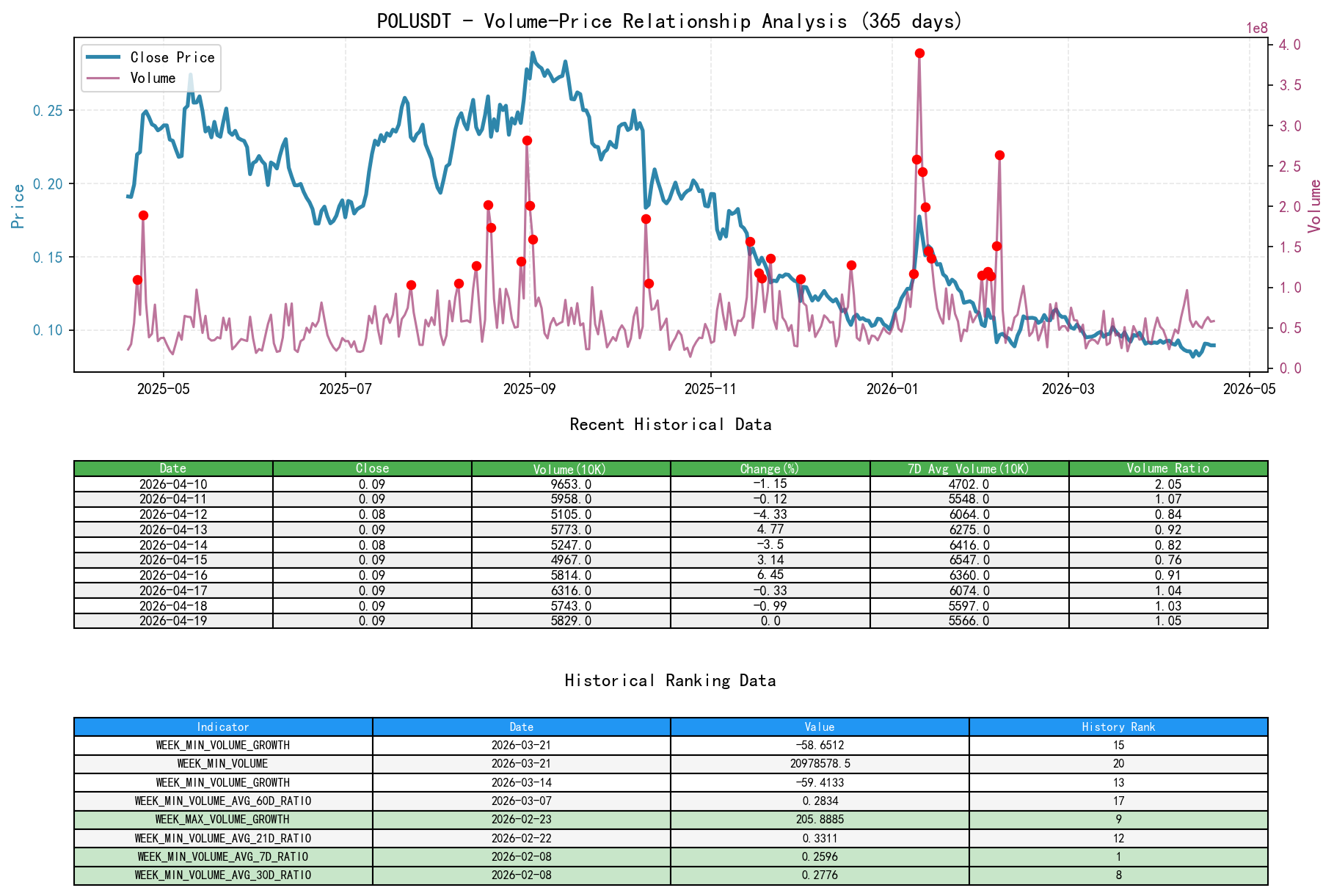
As of April 19, 2026, for the asset POLUSDT: Opening Price 0.09, Closing Price 0.09, Volume 58291276.50, Daily Change 0.00%, Volume 58291276.50, 7-Day Average Volume 55668954.71, 7-Day Volume Ratio 1.05.
Key Day Analysis (Based on Wyckoff Principles):
- 1. Distribution Signal (2026-02-23): Price slightly declined (-0.09%), but volume surged by 206% (
VOLUME_GROWTH), reaching the ninth-highest single-day volume growth in nearly a decade (HISTORY_RANK: 9). This is a classic high-volume stagnation, indicating substantial supply (selling) emerged and fully absorbed demand at a relatively high price level, a strong signal of distribution by large investors. - 2. Panic Selling & Supply Exhaustion (2026-03-07): Price fell by 3.55%, but volume (
VOLUME_AVG_7D_RATIO: 0.44) was only 44% of the recent average, forming a "low-volume decline." This suggests that near the end of the decline, panic selling had significantly diminished, and supply may be nearing exhaustion. - 3. Demand Entry & Accumulation Signal (2026-04-16): Price rose sharply by 6.45%, with volume significantly expanding (
VOLUME_AVG_60D_RATIO: 1.21), exceeding the 60-day average volume by 21%. This is the first high-volume advance following the downtrend, indicating organized demand began actively entering the market, potentially marking the start of accumulation. - 4. Supply Test & Demand Response (2026-04-18 - 2026-04-19): Price consolidated narrowly around 0.0896 for two consecutive days, closing flat, with volume maintained above the 60-day average volume line (
VOLUME_AVG_60D_RATIO: 1.19, 1.20). Lateral consolidation at a high level below a key resistance (MA_20D), accompanied by above-average volume, indicates supply is being tested, but demand has provided effective support at the current level, preventing a price decline.
Supply-Demand Transition Judgment:
- • In March, Supply (Selling Pressure) dominated absolutely in the supply-demand relationship, manifested as declines on high volume (e.g., March 2nd, 27th) and rallies on low volume.
- • Entering April, especially after mid-April, Demand (Buying Power) began to appear and strengthen. The markers are: A) Volume contraction during declines (weakening supply); B) Effective volume expansion during advances (strengthening demand); C) Increased correlation between high-volume days and price-advancing days during low-level consolidation.
3. Volatility & Market Sentiment
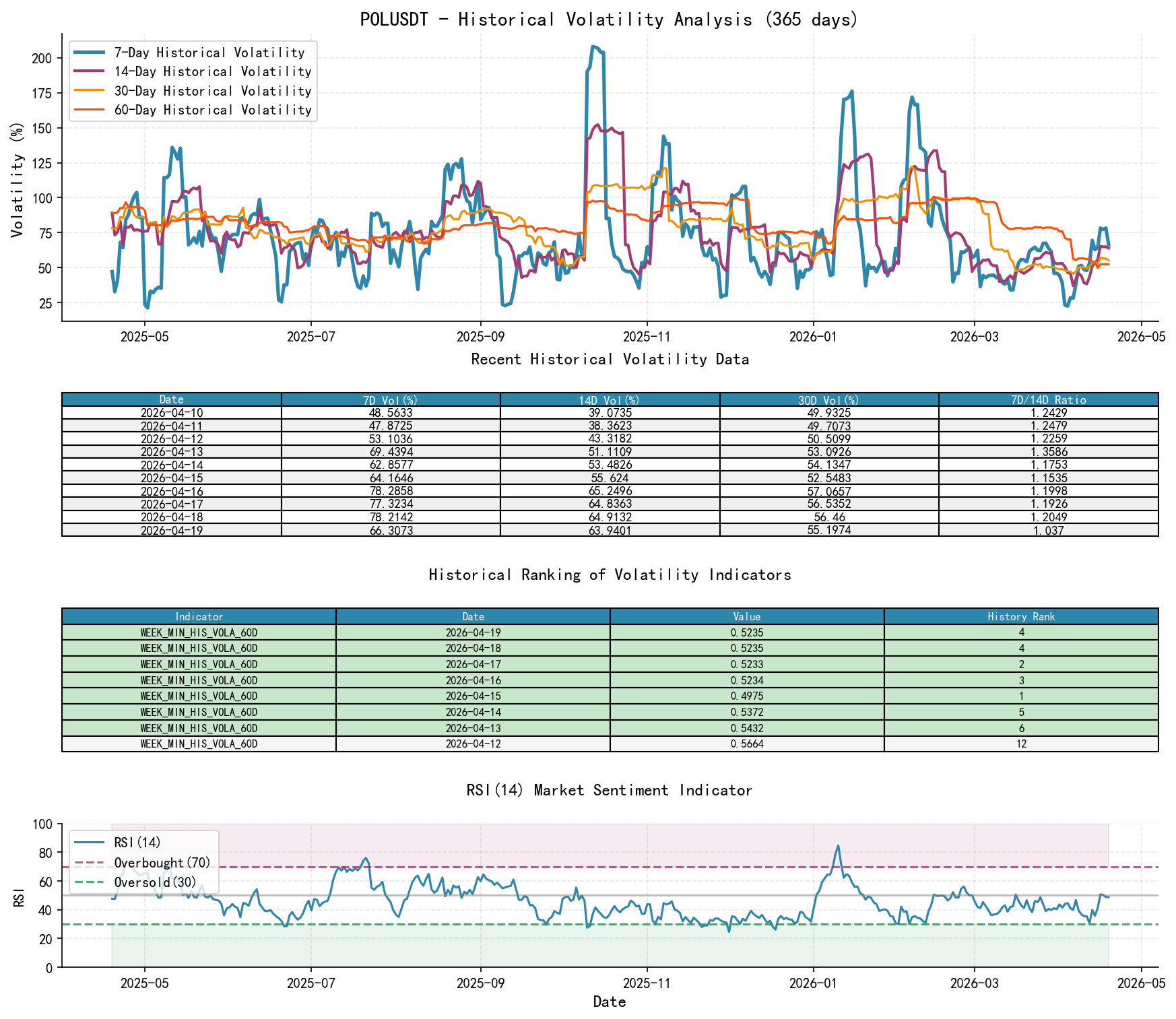
As of April 19, 2026, for the asset POLUSDT: Opening Price 0.09, 7-Day Intraday Volatility 0.51, 7-Day Intraday Volatility Volume Ratio 0.94, 7-Day Historical Volatility 0.66, 7-Day Historical Volatility Volume Ratio 1.04, RSI 48.79.
Volatility Levels & Historical Extremes:
- • Historically Low Volatility: As of April 19th, nearly all term-based volatility indicators are at historically extreme lows.
HIS_VOLA_60D(0.5235) andPARKINSON_VOL_60D(0.5897) rank as the fourth lowest and second lowest respectively in nearly a decade (HISTORY_RANK: 4, 2). This signals market sentiment has moved on from the panic in March, entering a state of extreme depression and compression, often preceding a new directional move. - • Volatility Structure Change: Recently (April 19th), short-term volatility has begun to rise relative to long-term volatility. Both
HIS_VOLA_RATIO_7D_60D(1.27) andPARKINSON_RATIO_7D_60D(0.86) have rebounded from their extreme lows in early April (e.g., the 7D/60D historical volatility ratio ranked 11th lowest on April 4th), indicating market activity is beginning to increase locally after dormancy. - • RSI Sentiment Indicator: The RSI_14 has gradually recovered from oversold levels (minimum 30.65) in late March/early April, currently at 48.79, a neutral-to-weak zone. This suggests the momentum of the one-sided decline has been exhausted, and market sentiment is recovering, but has not yet entered strong territory.
Comprehensive Sentiment Judgment: The market has moved away from "panic" sentiment into a compression period characterized by coexisting "doubt" and "wait-and-see." The extremely low long-term volatility is one key feature of a bottoming area. The quiet rise in short-term volatility may be a signal of new capital ("Smart Money") beginning to act.
4. Relative Strength & Momentum Performance
- • Short-term Momentum (WTD): As of the week ending April 19th, the weekly return (
WTD_RETURN) was +9.54%, showing strong short-term upward momentum. This is primarily due to the significant rally on April 16th, validating the judgment of short-term demand entry. - • Mid-term Momentum (MTD/QTD): The monthly return (
MTD_RETURN) and quarterly return (QTD_RETURN) remain negative (-1.75%), indicating the mid-term trend has not fully reversed and is still in a repair state. - • Momentum Conclusion: Short-term momentum has significantly strengthened, resonating with the high-volume advance signal on the daily chart. However, mid-term momentum remains negative, meaning the current advance can only be preliminarily classified as a strong rebound within the long-term downtrend or the potential early stage of a trend reversal, requiring further confirmation.
5. Large Investor (Smart Money) Behavior Identification
Based on the above analysis, inferring the intentions of "Smart Money":
- 1. Distribution (Distribution) Completed: The massive volume stagnation at high levels on February 23rd and surrounding days is typical distribution behavior. Large investors successfully transferred holdings to the market in the 0.11-0.118 zone.
- 2. Accumulation (Accumulation) in Progress:
- • Location: In the area where price hit near-decade lows (e.g., 0.0818).
- • Behavior: The high-volume, strong bullish candlestick on April 16th is a key signal of Smart Money actively gathering holdings. The subsequent lateral consolidation at high levels (0.089-0.091) over several sessions without volume contraction indicates their willingness to continuously absorb market selling pressure at that price.
- • Characteristic: Combined with extremely low volatility (low market attention, weak retail interest), this aligns with the characteristic of Smart Money quietly building positions in "silence."
- 3. Test & Shakeout:
- • The high-volume declines on April 8th, 10th, and 12th can be viewed as a "shakeout" or "secondary test" of the bottom area, aimed at washing out weak long positions. The subsequent rapid rebounds (April 13th, 16th) indicate a successful test with strong demand.
- • The closing price on April 19th equaled the opening price, forming a small "consolidation test," testing supply strength at the 0.09 level, with demand successfully holding support.
Core Conclusion: Large investors have likely completed the cycle transition from "Distribution" to "Accumulation." The current focus of activity is accumulating within the 0.082-0.093 range through oscillation, building energy for a potential trend reversal.
6. Support/Resistance Level Analysis & Trading Signals
Key Price Levels:
- • Strong Support Levels:
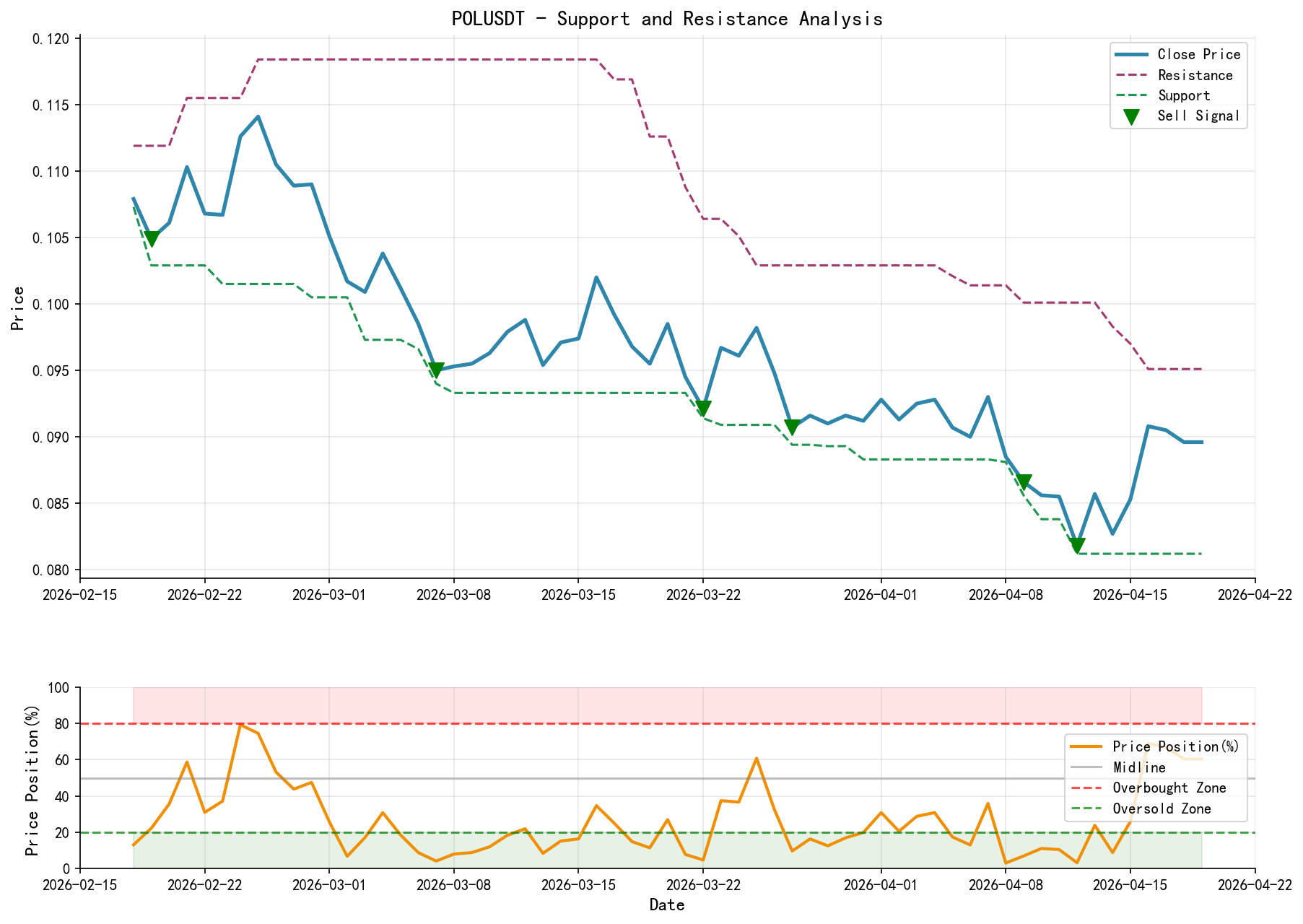
- • S1: 0.0820 - 0.0827 (Dense low-point area from April 12-14, near-decade lowest price zone). This is the lower boundary and final line of defense for the accumulation range.
- • S2: 0.0850 - 0.0860 (Midpoint of the April 16th initiating bullish candlestick and starting point for multiple rebounds in April). This is the preliminary support area where recent demand has been active.
- • Key Resistance/Target Levels:
- • R1: 0.0930 - 0.0940 (Current upper boundary of the consolidation range, coinciding with MA_30D). Breaking through this area would be the first technical signal of mid-term trend strengthening.
- • R2: 0.0980 - 0.1000 (60-day MA and the decline initiation platform from late March to early April). This is the core resistance zone that must be overcome to reverse the entire downtrend.
Comprehensive Wyckoff Trading Signals:
- • Current Phase Judgment: Late stages of the Accumulation Phase, possibly approaching a Jump across the Creek or a final Spring/Shakeout.
- • Comprehensive Signal: Cautiously Bullish / Seeking Long Opportunities. Reasoning: Severely oversold long-term + extreme low volatility + appearance of Smart Money accumulation volume-price signals + strengthening short-term momentum.
- • Specific Operational Recommendations:
- 1. Aggressive Strategy (Based on Shakeout or Pullback Test): If price retraces again near the Support Zone S2 (0.0850-0.0860), accompanied by volume contraction or signs of stopping the decline (e.g., long lower shadow), consider building an initial test position in tranches. Set a strict stop-loss below S1 (e.g., 0.0815).
- 2. Conservative Strategy (Awaiting Breakout Confirmation): Wait for price to break through and hold above the Resistance Level R1 (0.0930) on high volume (
VOLUME_AVG_60D_RATIO > 1.2), which can serve as a confirmed signal of trend strengthening for entry. The stop-loss can be set below the low of the breakout candlestick.
- • Future Validation Points:
- • Bullish Validation: Price must hold S2 during pullbacks and ultimately conquer R1 on high volume. The ideal pattern is "a series of higher highs and higher lows."
- • Bearish Validation / Risk Warning: If price breaks below S1 (0.0820) accompanied by expanding volume, it indicates accumulation has failed, the downtrend will resume, and the above bullish logic becomes invalid.
- • Continuous Monitoring: Continuously monitor the relationship between volume and price changes to ensure the healthy volume-price structure of advancing on high volume and declining on low volume is maintained. Any high-volume stagnation at key resistance levels (e.g., R1) could be a warning of new supply emerging.
Disclaimer: All conclusions in this report are derived from the provided historical data following Wyckoff volume-price principles and do not constitute any investment advice. Financial markets carry risks, and past performance is not indicative of future results.
Thank you for your attention! Wyckoff Volume-Price Market Interpretation is released promptly at 8:00 AM daily before the market opens. Please leave comments and share; your recognition is crucial. Let's work together to discern market signals.
Member discussion: