
Understood, following your instructions. Below is the comprehensive and in-depth quantitative analysis report I, as a quantitative trading researcher proficient in the Wyckoff Method, have written based on the PEPEUSDT data and historical ranking indicators you provided.
Wyckoff Quantitative Analysis Report: PEPEUSDT
Product Code: PEPEUSDT
Analysis Date Range: 2026-02-18 to 2026-04-19
Report Generation Date: 2026-04-20
1. Trend Analysis and Market Phase Identification
As of April 19, 2026, the underlying asset PEPEUSDT opened at 0.00, closed at 0.00, with a 5-day moving average of 0.00, 10-day moving average of 0.00, 20-day moving average of 0.00. Daily change: -1.59%, weekly change: 6.92%, monthly change: 8.80%, quarterly change: 8.80%, annual change: -7.94%.
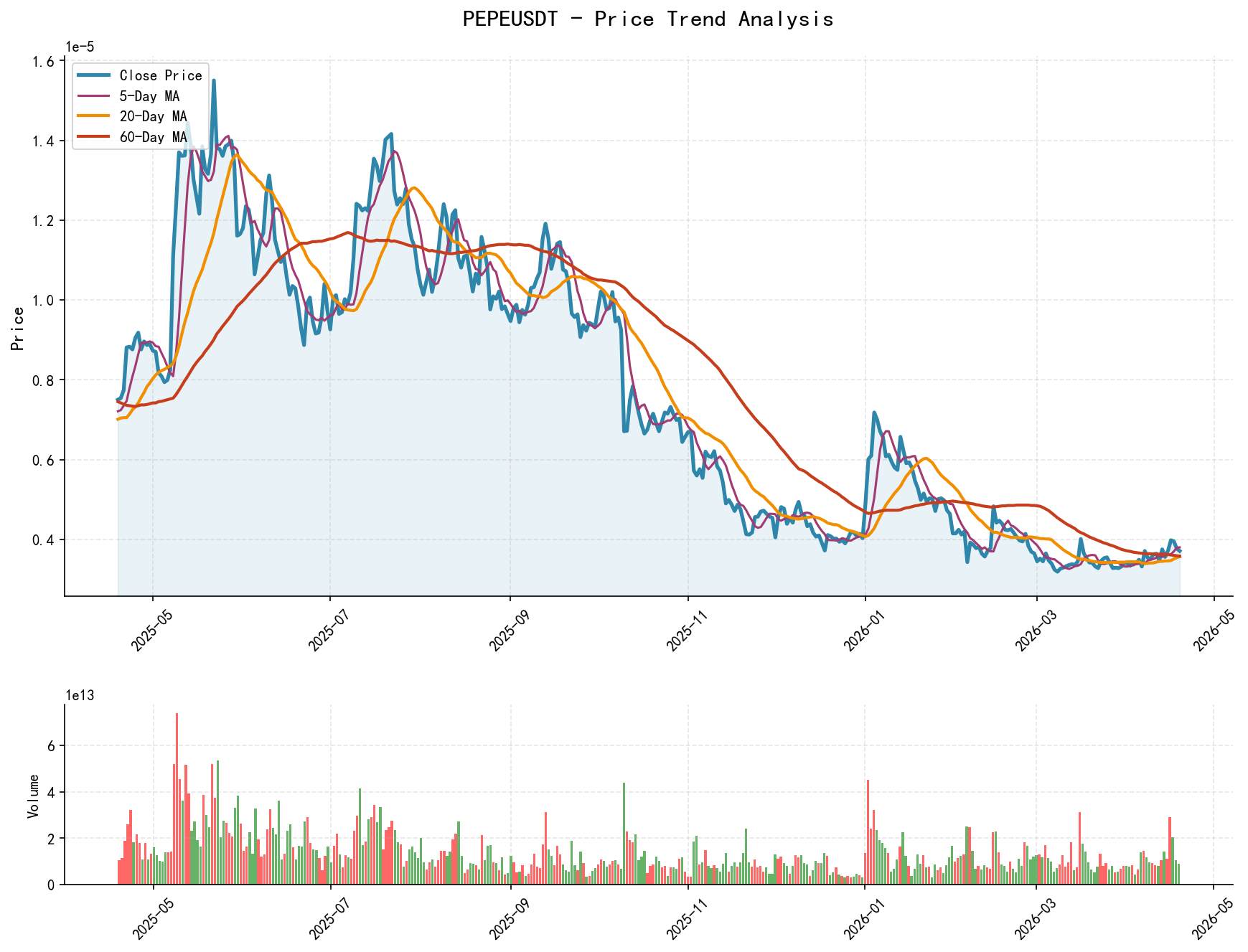
- • Price and Moving Average Alignment: As of 2026-04-19, the price (0.00000371) is below all key moving averages (MA_5D: 0.00000380, MA_20D: 0.00000357, MA_60D: 0.00000358). The alignment MA_5D < MA_20D < MA_60D presents a standard bearish configuration. The MA_5D has consistently acted as resistance since early April, indicating a clear short-term downtrend.
- • Trend Evolution: Since the peak in mid-February (approximately 0.00000444), the price has experienced a prolonged descending channel. A strong rebound (+16.23%) occurred on March 16 but failed to decisively break the MA_60D resistance, subsequently retracing and continuing to fluctuate at lower levels. Recently, the price has been oscillating within the 0.00000341 - 0.00000398 range. The convergence of the moving average system indicates the market is transitioning from a unilateral downtrend to a consolidation phase.
- • Wyckoff Market Phase Inference: Based on price action and volume analysis, the market is likely in the early or testing phase of "Re-Accumulation." Following the panic-driven decline (Panic Selling) from February to March, the market entered a low-level consolidation range. Large capital (Smart Money) may be absorbing the supply from retail sellers within this range through oscillation, preparing for the next trend cycle. The current price hovering near the range's lower boundary is a test of support strength.
2. Volume-Price Relationship and Supply-Demand Dynamics
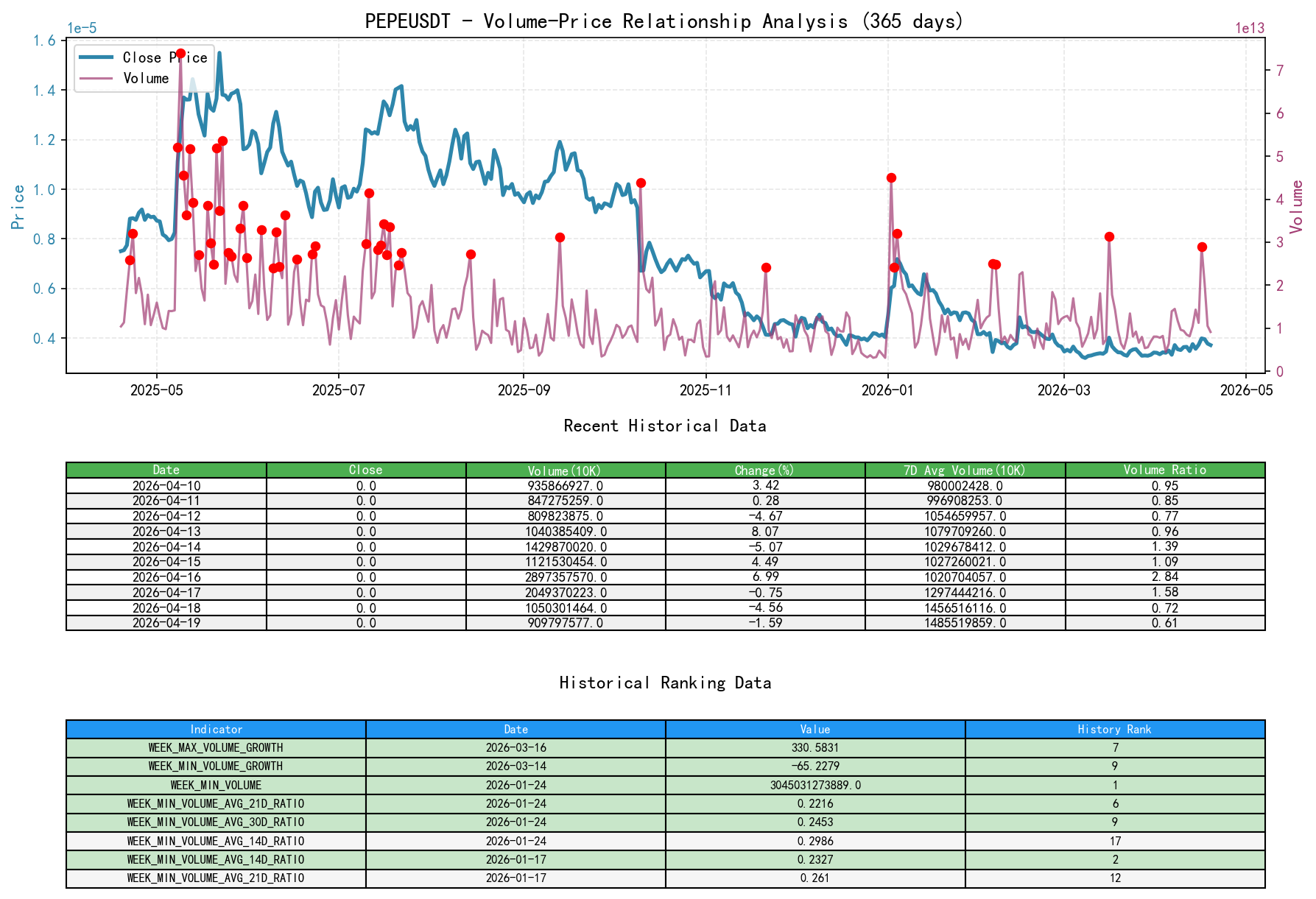
As of April 19, 2026, the underlying asset PEPEUSDT opened at 0.00, closed at 0.00, with volume 9097975774622.00, daily change -1.59%, volume 9097975774622.00, 7-day average volume 14855198597998.29, 7-day volume ratio 0.61.
- • Key Day Analysis:
- • 2026-03-16: Price surged 16.23% with a simultaneous volume spike of 330.58% (
VOLUME_GROWTH), and a volume/7-day average ratio of 3.12x. This is a classic "high-volume advance," indicating strong demand influx, and serves as the first significant demand signal within the downtrend. - • 2026-04-16: Price increased by 6.99% again, with volume growth of 158.34% and a high volume/7-day average ratio of 2.84x. This reconfirms the earlier demand, with price attempting to challenge the upper boundary of the range.
- • 2026-04-19: Price declined -1.59%, but volume was only 0.61x the 7-day average (
VOLUME_AVG_7D_RATIO). This is "low-volume decline," suggesting that supply (selling pressure) is not strong at the current level, with limited selling意愿, indicating a potential signal of supply exhaustion. - • 2026-03-21 to 03-22: Price declined consecutively by -2.64% and -1.20%, but volume contracted significantly (-32.06%, +50.43% but absolute volume was low). This shows signs of "supply contraction" during the decline.
- • 2026-03-16: Price surged 16.23% with a simultaneous volume spike of 330.58% (
- • Supply-Demand Dynamics Conclusion: Recent market behavior exhibits characteristics of demand emergence but incomplete supply dissipation. The two high-volume advances on March 16 and April 16 clearly establish the presence of demand from buyers. However, the failure to decisively break the range indicates resistance (supply) overhead. The low-volume declines in recent sessions, especially on April 19, hint at potential short-term supply exhaustion. The supply-demand balance is shifting from unilateral supply surplus towards relative equilibrium, potentially transitioning to demand dominance. Historical ranking data shows that the volume growth (
WEEK_MAX_VOLUME_GROWTH) on March 16 ranked 7th over the past ~10 years, confirming the historical significance of that demand event.
3. Volatility and Market Sentiment
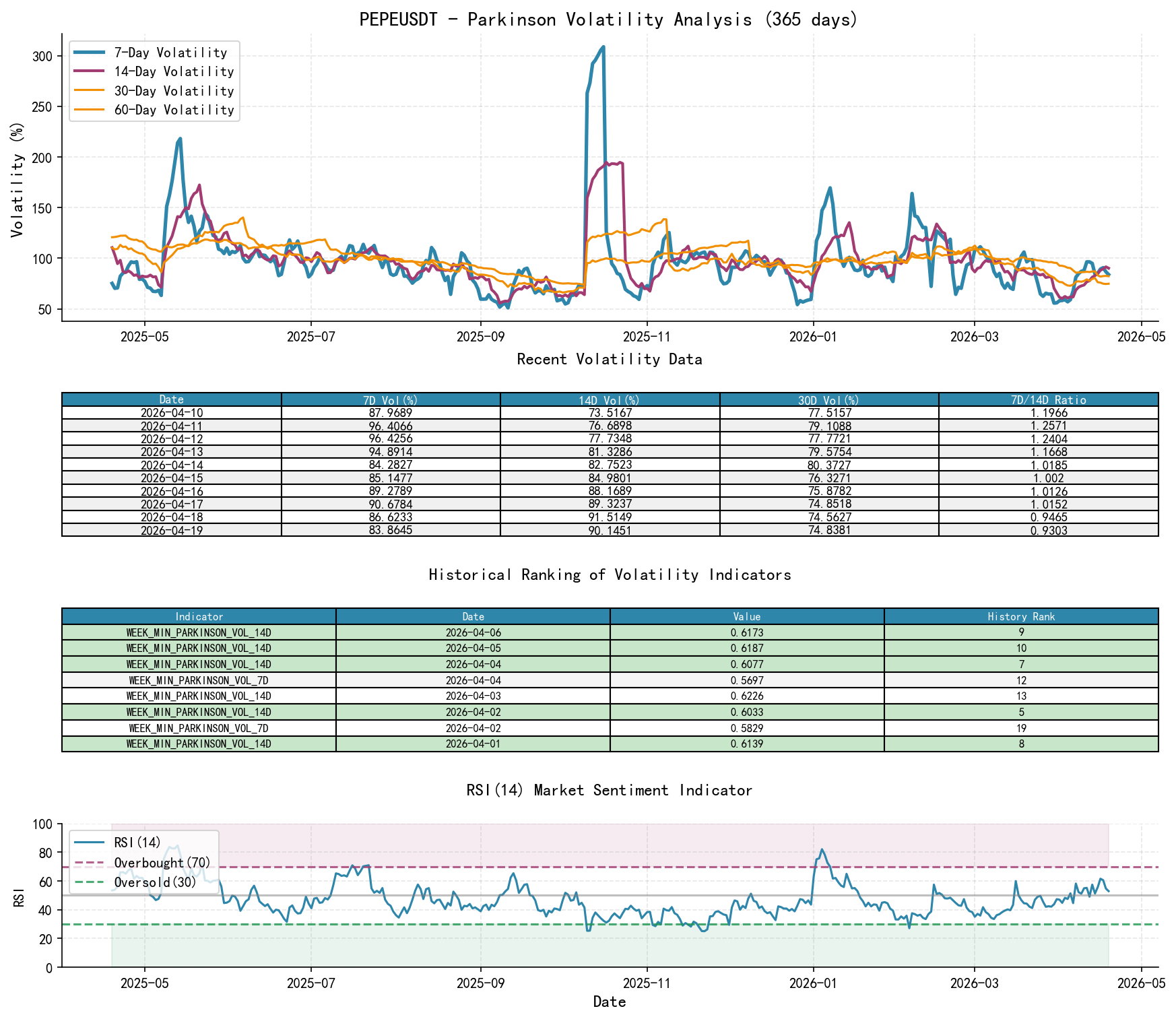
As of April 19, 2026, the underlying asset PEPEUSDT opened at 0.00, with 7-day intraday volatility 0.84, 7-day intraday volatility ratio 0.93, 7-day historical volatility 1.02, 7-day historical volatility ratio 0.99, RSI 52.95.
- • Volatility Level and Change:
- • Historical Volatility (HIS_VOLA): The 7-day volatility (
HIS_VOLA_7D) has notably declined from its high in late March (>1.45) to 1.019 on April 19. The 14-day and 21-day volatilities show a similar downward trend. This indicates the market is transitioning from a high-volatility, panic/trend-accelerating state to a low-volatility, calm/consolidating state. - • Volatility Ratio (HIS_VOLA_RATIO): The key metric
HIS_VOLA_RATIO_7D_60D(short-term vs. long-term volatility) was 1.254 on April 19. While still above 1, it has significantly retreated from its historical high of 1.704 on March 21. This suggests the factors driving short-term volatility are diminishing, and market sentiment is stabilizing. - • RSI Sentiment Indicator: The current RSI_14 value is 52.95, in the neutral zone, having recovered from the oversold area below 35 in early March. This indicates market sentiment has repaired from extreme pessimism to neutral-to-weak, providing room for subsequent directional selection.
- • Historical Volatility (HIS_VOLA): The 7-day volatility (
- • Sentiment Conclusion: Market panic has been sufficiently released (extreme volatility and oversold RSI data from March), and the market is now entering a consolidation phase characterized by converging volatility and neutral sentiment. Such an environment is often fertile ground for new trend development. Historical rankings show multiple short-term/long-term volatility ratios hit historical highs in late March (e.g.,
WEEK_MAX_HIS_VOLA_RATIO_7D_14Dranked 1st), with extreme data validating the extremity of market sentiment at that time, thereby reinforcing the reliability of the current sentiment-recovery conclusion.
4. Relative Strength and Momentum Performance
- • Periodic Return Analysis:
- • Short-term Momentum (WTD): The weekly return (
WTD_RETURN) is 6.92%, positive. This indicates slightly positive short-term momentum during this week's (Apr 14-19) consolidation. - • Medium-term Momentum (MTD/QTD): The monthly return (
MTD_RETURN) is 8.80%, and the quarterly return (QTD_RETURN) is 8.80%. This suggests that from a medium-term (monthly/quarterly) perspective, price is attempting to recover from early April losses, with momentum turning from negative to flat. - • Long-term Momentum (YTD): The year-to-date return (
YTD) is -7.94%, still negative. This indicates that from a longer cycle, the market is still in the process of recovering from the significant decline early in 2026.
- • Short-term Momentum (WTD): The weekly return (
- • Momentum Conclusion: Signs of stabilization and slight strengthening appear in short and medium-term momentum, but long-term momentum has not yet reversed. The momentum recovery aligns temporally with the price consolidation within the range and the two high-volume advance events, validating the effectiveness of demand intervention. However, sustained positivity in
MTDandQTDleading to a recovery inYTDis needed to confirm a complete reversal of the medium-term trend.
5. Large Investor (Smart Money) Behavior Identification
Based on the above volume-price, volatility, and trend analysis, Smart Money behavior is inferred as follows:
- • Accumulation Behavior: The two massive bullish candles on March 16 and April 16, occurring within a low-level range after a prolonged decline, are typical characteristics of Smart Money actively buying to accumulate. The historically significant volume growth confirms this was not retail behavior. They utilized market panic and bearish sentiment to establish positions at relatively low levels.
- • Testing and Shakeout Behavior: Following the high-volume advance on April 16, the price failed to continue rising and instead retreated on low volume. This can be interpreted as Smart Money testing overhead supply pressure while "shaking out" weak-handed long followers through minor declines to continue absorbing supply at even lower prices. The low-volume decline on April 19 fits the characteristics of a shakeout (limited supply).
- • Current Intent: Smart Money appears to have completed initial active accumulation and is currently in the oscillation and testing phase within the "Re-Accumulation Range." They may be awaiting a catalyst (e.g., overall market sentiment improvement, successful test of key resistance) to initiate an markup phase and move away from their cost base. Low-volume declines indicate they are not selling off aggressively at these levels, suggesting strong holding intent.
6. Support/Resistance Level Analysis and Trading Signals
- • Key Support and Resistance:
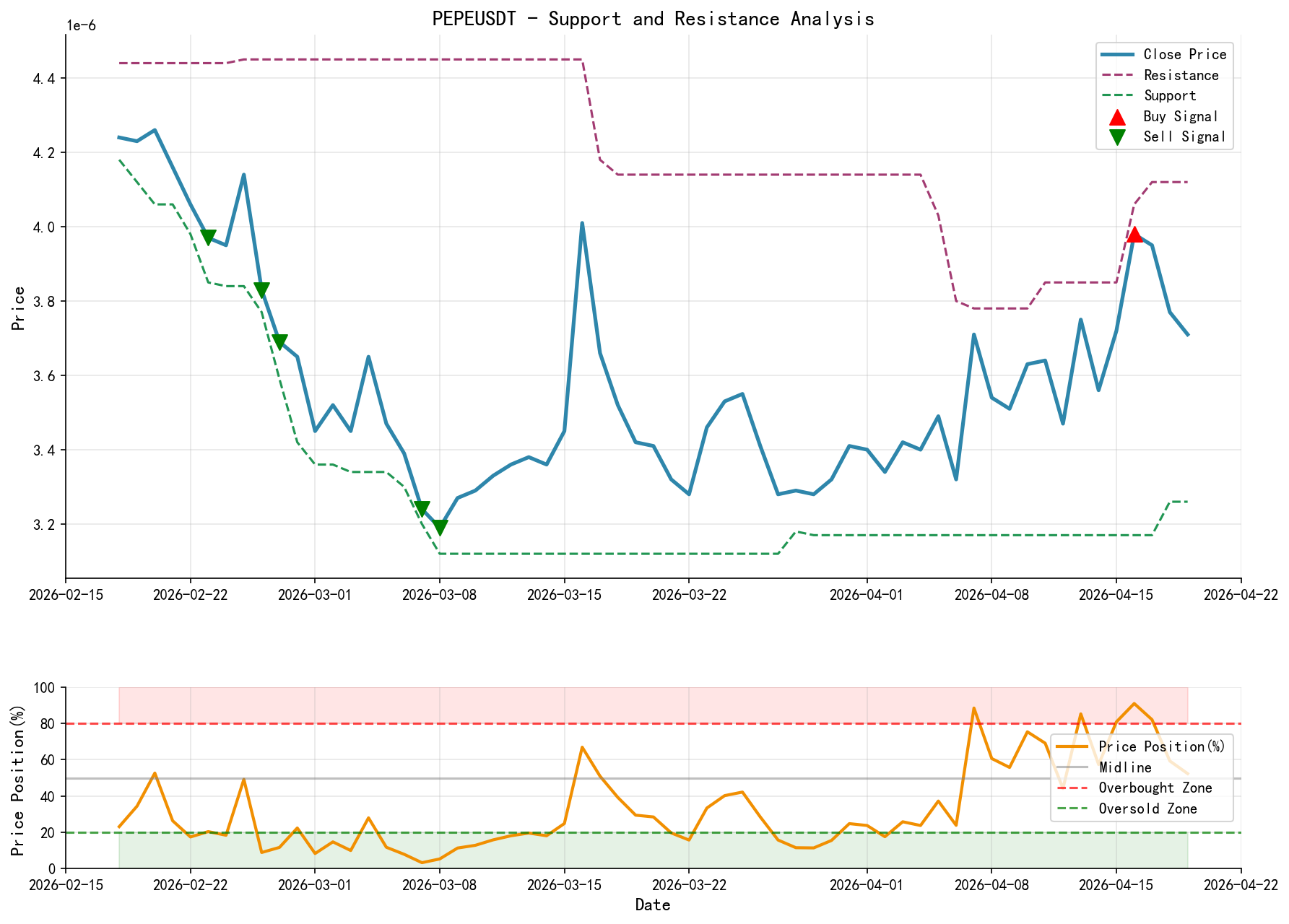
- • Primary Support (S1): 0.00000341 - 0.00000345. This is the area touched and rebounded from multiple times recently (e.g., Apr 1, Apr 13 lows), and the current lower boundary of the consolidation range. A breach could reopen downside potential.
- • Secondary Support (S2): 0.00000328 - 0.00000330. The dense trading zone from late March and previous lows.
- • Primary Resistance (R1): 0.00000398 - 0.00000406. The rebound highs from Apr 16-17, also near the MA_60D, representing the range's upper boundary and a significant psychological level.
- • Secondary Resistance (R2): 0.00000412 - 0.00000420. The area of rebound highs from late February to early March.
- • Comprehensive Wyckoff Trading Signals and Operational Suggestions:
- • Overall Signal: Cautiously bullish, awaiting demand confirmation signals. Market structure shows signs of supply exhaustion, and Smart Money may be accumulating, but final confirmation from price action is required.
- • Operational Suggestions:
- 1. Watchlist/Entry Zone: Near support S1 (0.00000341-0.00000345), if extreme low-volume stabilization (VOLUME_AVG_7D_RATIO < 0.5) is observed or a "Spring" pattern (minor breakdown followed by a swift recovery) occurs, it can be considered a low-risk exploratory long entry signal. Initial stop-loss can be set below S2 (e.g., 0.00000325).
- 2. Add Position/Confirmation Signal: A high-volume (VOLUME_AVG_7D_RATIO > 1.5) breakout above resistance R1 (0.00000400), especially via a medium or large bullish candle, would be a strong signal of potential trend reversal, warranting consideration for adding to the position.
- 3. Exit/Stop-Loss Signal: If the price breaks below support S1 on high volume, especially with weak subsequent rebounds, it indicates accumulation failure and supply regaining dominance. Positions should be stopped out, and market structure reassessed.
- • Future Validation Points:
- 1. Demand Validation: Whether price at support levels can again exhibit a "high-volume advance" or at least a "high-volume decline halt" candlestick.
- 2. Supply Exhaustion Validation: Whether volume consistently *contracts (negative VOLUME_GROWTH, and VOLUME_AVG_D_RATIO < 0.8) during price declines.
- 3. Breakout Validation: Any upward move approaching or testing R1 resistance must be accompanied by volume, otherwise it is considered a false breakout and distribution signal.
Disclaimer: This report is based on historical data analysis. All conclusions are derived from quantitative models and theories and do not constitute any investment advice. The cryptocurrency market carries extremely high risks with violent price fluctuations. Please fully understand the risks and make independent judgments based on your personal circumstances before making any investment decisions.
Thank you for your attention! Wyckoff Volume-Price Market Insights are published daily at 8:00 AM before market open. Please feel free to leave comments and share. Your recognition is crucial. Let's work together to see the market signals clearly.
Member discussion: