
Okay, following your instructions. As a quantitative trading researcher proficient in the Wyckoff Method, I will write a comprehensive and in-depth quantitative analysis report based on the ETHUSDT data you provided.
ETHUSDT Quantitative Analysis Report (Based on Wyckoff Principles)
Product Code: ETHUSDT
Analysis Date Range: 2026-02-18 to 2026-04-19
Report Generation Date: 2026-04-20
1. Trend Analysis and Market Phase Identification
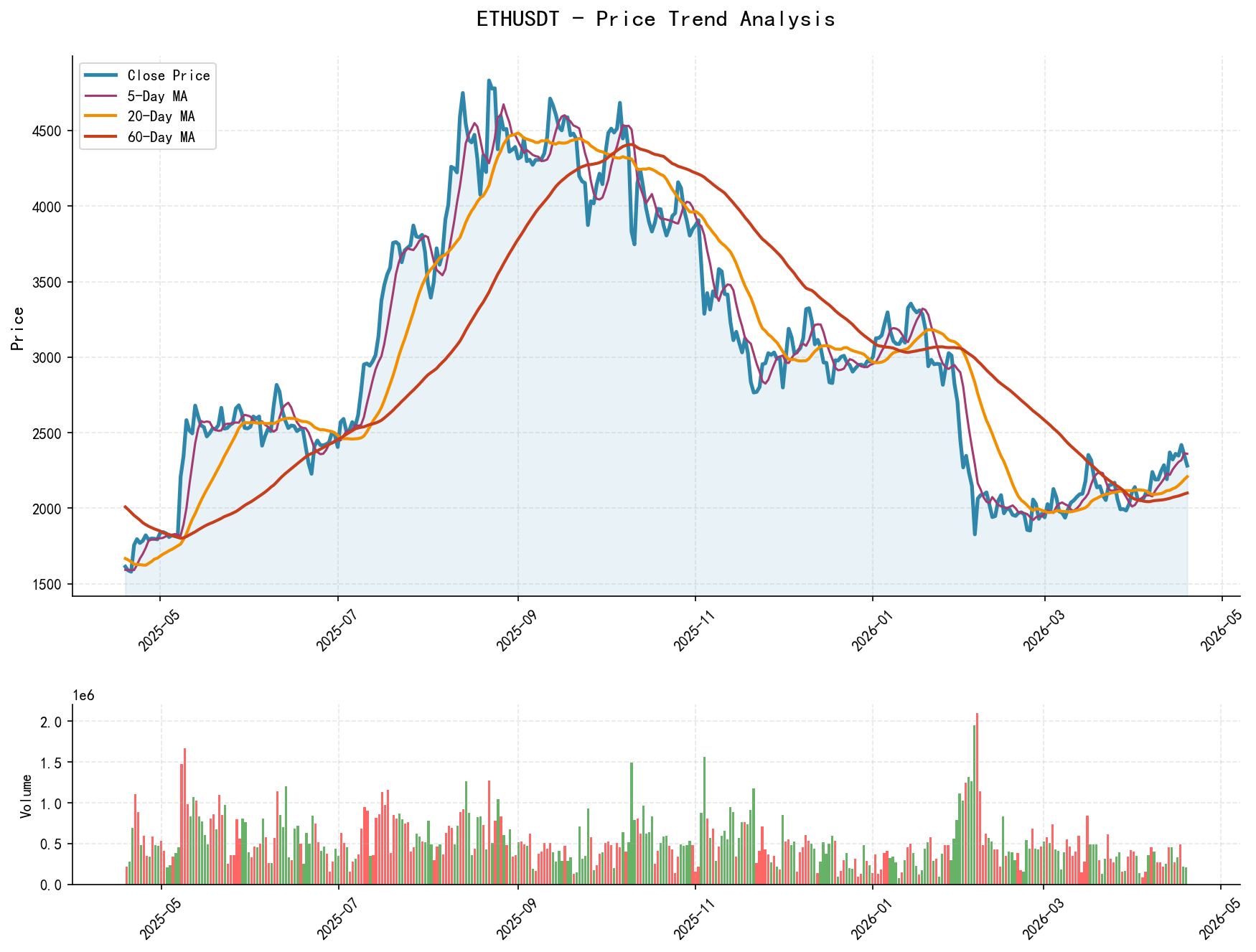
As of 2026-04-19, the underlying asset ETHUSDT has an open price of 2350.33, a close price of 2281.71, with moving averages at 2359.98 (5-day), 2308.12 (10-day), 2208.87 (20-day). The daily change is -2.92%, the weekly change is 4.11%, the monthly change is 8.37%, the quarterly change is 8.37%, and the annual change is -23.22%.
- • Moving Average Alignment and Trend Judgment:
At the end of the analysis period, the price ($2,281.71) is above the MA_20D ($2,208.87) and MA_30D ($2,165.74) but is suppressed by the MA_5D ($2,359.98) and MA_10D ($2,308.12), and remains significantly below the long-term MA_60D ($2,100.56). This indicates that the long-term downtrend (price below MA_60D) has not yet reversed, but the medium-term trend (MA_20D/30D) has shifted to sideways consolidation with a slight bullish bias. The short-term trend (MA_5D/10D) has weakened due to recent pullbacks. The moving average system shows a convergent and aggregated state, suggesting the market is in a consolidation phase preceding a directional choice. - • Price Action and Inferred Wyckoff Phase:
Reviewing the entire cycle, the market has experienced clear Wyckoff cycle phases:- • Panic Selling (PS) & Automatic Rally (AR): On 2026-02-23, price plummeted by 5.19% to $1,856.30 (WTD_RETURN -7.11%) on high volume, marking the cycle low, aligning with panic selling characteristics. Subsequently, on February 25th, the market rallied strongly by 11.10% on massive volume (VOLUME_AVG_7D_RATIO 1.99), forming an Automatic Rally.
- • Secondary Test (ST) & Accumulation Zone: Between February 27th and the end of March, the price repeatedly tested the $1,850 - $2,000 zone, but with significantly diminished volume (e.g., on March 7th and 21st, VOLUME_AVG_21D_RATIO as low as 0.29-0.41) without breaking below the previous low. This low-volume consolidation and testing within a low-price range are classic signs of Accumulation. The price broke above the MA_20D on March 16th on increased volume.
- • Markup: From mid-March to early April, the price rose from $2,100 to $2,419 with incremental volume, establishing higher highs and confirming entry into the Markup phase.
- • Distribution or Re-test: After reaching a high of $2,369.46 on April 11th, the price pulled back, accompanied by a volume-augmented decline on April 19th (VOLUME_GROWTH -5.56%, but price fell -2.92%). The market is currently testing the support from the prior advance; whether this is a pullback or the start of a Distribution phase requires subsequent confirmation from price and volume.
Conclusion: The market has likely completed the transition from "Panic Selling" in late February to "Accumulation," and then to "Markup" in March-April. Currently, it is in a pullback testing phase following the advance. The key observation is whether it receives a demand response at support levels.
2. Volume-Price Relationship and Supply-Demand Dynamics
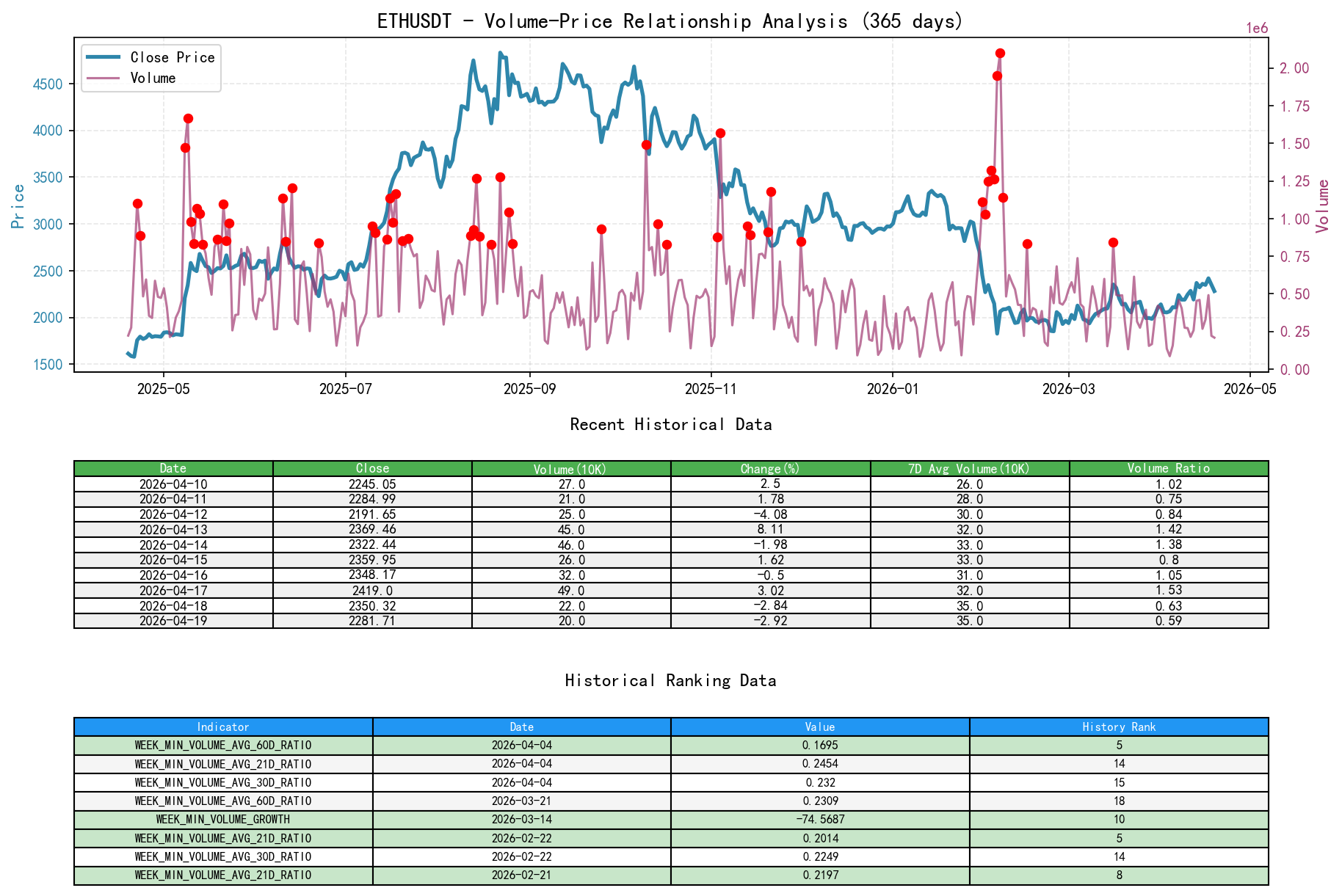
As of 2026-04-19, the underlying asset ETHUSDT has an open price of 2350.33, a close price of 2281.71, volume of 209413.01, daily change of -2.92%, 7-day average volume of 354679.92, and a 7-day volume ratio of 0.59.
- • Key Day Analysis:
- • Supply-Dominated Days (High-Volume Decline):
- • 2026-02-23: PCT_CHANGE -5.19%, VOLUME_AVG_7D_RATIO 1.76. Panic Selling, with massive supply flooding the market, although the enormous volume itself also suggests funds were absorbing it.
- • 2026-04-19 (Latest Trading Day): PCT_CHANGE -2.92%, VOLUME_AVG_7D_RATIO 0.59. Decline on increased volume, though volume is not at extreme levels, indicating supply has re-emerged but not at panic levels.
- • Demand-Dominated Days (High-Volume Advance):
- • 2026-02-25: PCT_CHANGE +11.10%, VOLUME_AVG_7D_RATIO 1.99. Strong demand entry, recovering most losses from the panic day, marking the potential starting point for a trend reversal.
- • 2026-03-16: PCT_CHANGE +8.02%, VOLUME_AVG_7D_RATIO 2.12. Breakout advance on high volume, demand firmly in control, confirming the uptrend.
- • Demand Exhaustion Days (Low-Volume Advance/Stalling):
- • 2026-04-11 & 04-12: Price consolidated narrowly in the $2,284-$2,369 high range for two consecutive days, ultimately closing lower. Volume shrank relative to recent averages (VOLUME_AVG_7D_RATIO 0.75, 0.84). This is a signal of weakening advance and initial supply emergence, foreshadowing the subsequent pullback.
- • Supply Exhaustion Days (Low-Volume Decline):
- • 2026-03-07 & 03-21: Price declined modestly with extremely low volume (VOLUME_AVG_21D_RATIO as low as 0.29, 0.23). Indicates lack of persistent supply following the decline, a typical feature of the Accumulation phase.
- • Supply-Dominated Days (High-Volume Decline):
- • Volume Anomalies and Supply-Demand Shifts:
- • Supply Exhaustion Signals: During the Secondary Tests in early March, extremely low volume ratios occurred multiple times (e.g., February 22nd, WEEK_MIN_VOLUME_AVG_21D_RATIO 0.2014, ranking 5th lowest in the past decade), confirming supply exhaustion.
- • Demand Initiation Signal: On March 16th, VOLUME_AVG_7D_RATIO reached 2.12, showing sudden, powerful demand influx into the market.
- • Current State: Volume has declined from highs in late April and increased during the price decline (April 19th), indicating that the short-term supply-demand balance has been broken, with supply temporarily dominant. It is crucial to observe whether the decline continues with persistently increasing volume (expanding supply) or decreasing volume (healthy correction).
3. Volatility and Market Sentiment
As of 2026-04-19, the underlying asset ETHUSDT has an open price of 2350.33, a 7-day intraday volatility of 0.57, a 7-day intraday volatility ratio of 0.99, a 7-day historical volatility of 0.75, a 7-day historical volatility ratio of 1.12, and an RSI of 54.01.

- • Volatility Level and Changes:
- • Volatility Compression: Around February 22nd, short-term volatility dropped to extremely low levels (HIS_VOLA_7D 0.217, PARKINSON_VOL_7D 0.418), while volatility ratios were also at extreme lows (WEEK_MIN_HIS_VOLA_RATIO_7D_21D 0.2152, ranking 6th; WEEK_MIN_PARKINSON_RATIO_7D_21D 0.5169). This is a classic volatility squeeze, often preceding a significant directional move.
- • Volatility Expansion: The powerful rally following the February 25th panic and the March 16th breakout were both accompanied by a rapid surge in short-term volatility (HIS_VOLA_7D >0.9). Notably, on March 1st, WEEK_MAX_HIS_VOLA_RATIO_7D_14D reached 1.4395, ranking 3rd highest in the past decade, marking a violent expansion of volatility from extreme compression, with the trend beginning to accelerate.
- • Current Sentiment: As of April 19th, HIS_VOLA_7D is 0.745, above the 60-day average (0.647) but has retreated from its mid-April high. The RSI_14 has retreated from overbought territory on April 17th (64.84) to 54.01, entering neutral-to-weak territory. This suggests excessive optimism triggered by the advance has been alleviated, and market sentiment is cooling.
4. Relative Strength and Momentum Performance
- • Multi-Cycle Momentum Analysis:
- • Short-term Momentum (WTD_RETURN): Extremely volatile. Transitioned from the strong +18.06% in the week of March 16th to a slowed advance of +4.11% for the week ending April 19th (rising then falling within the week), indicating weakening short-term upward momentum.
- • Mid-term Momentum (MTD_RETURN): Recovered robustly from deep negative territory in late February (-20%+) to +8.37% as of April 19th. Despite the second-half-of-April pullback, momentum within the month remains positive, suggesting the medium-term trend structure is still intact.
- • Long-term Momentum (YTD/QTD): Although YTD remains negative at -23.22%, QTD has turned positive (+8.37%). This indicates significant improvement in relative strength since the beginning of Q2 compared to the extreme weakness at the start of the year.
Conclusion: Short-term momentum faces pullback pressure, but mid-cycle momentum remains robust, and long-cycle momentum shows signs of bottoming and recovery. Momentum analysis is consistent with the phase judgment of a "healthy pullback following an advance."
5. Large Investor (Smart Money) Behavior Identification
Based on Wyckoff principles and volume-price data, the inferred behavior of large investors is as follows:
- 1. Accumulation: During the Panic Selling in late February, massive volume (e.g., February 23rd) indicates not only retail selling but also large-scale funds absorbing panic selling at low prices. The subsequent weeks of low-volume Secondary Testing are signs of smart money controlling price and continuing to accumulate positions, with their cost base roughly around $1,850-$2,000.
- 2. Markup & Shakeout: The high-volume advance on and after March 16th represents smart money pushing the price out of its cost base, attracting market attention and follower buying. The pullback and consolidation from early to mid-April can be seen as a shakeout, washing out weak longs.
- 3. Distribution Attempt or Test: In mid-April, price exhibited high-volume stalling (April 11th-12th) and high-volume decline (April 19th) in the $2,350-$2,420 zone. This suggests smart money may have engaged in partial profit-taking (distribution) or actively tested supply pressure at higher levels to assess the sustainability of the advance.
- 4. Current Intent: Smart money is observing market reactions as price pulls back to key support levels (e.g., $2,200-$2,250 zone around MA_20D/30D). If low-volume stabilization or demand-driven high-volume rebounds appear, it indicates their intent to sustain the uptrend and potentially add positions again. If there is a sustained high-volume break below key support, it suggests stronger distribution intent, potentially leading to a deeper correction.
6. Support/Resistance Level Analysis and Trading Signals
- • Key Levels:
- • Primary Support:
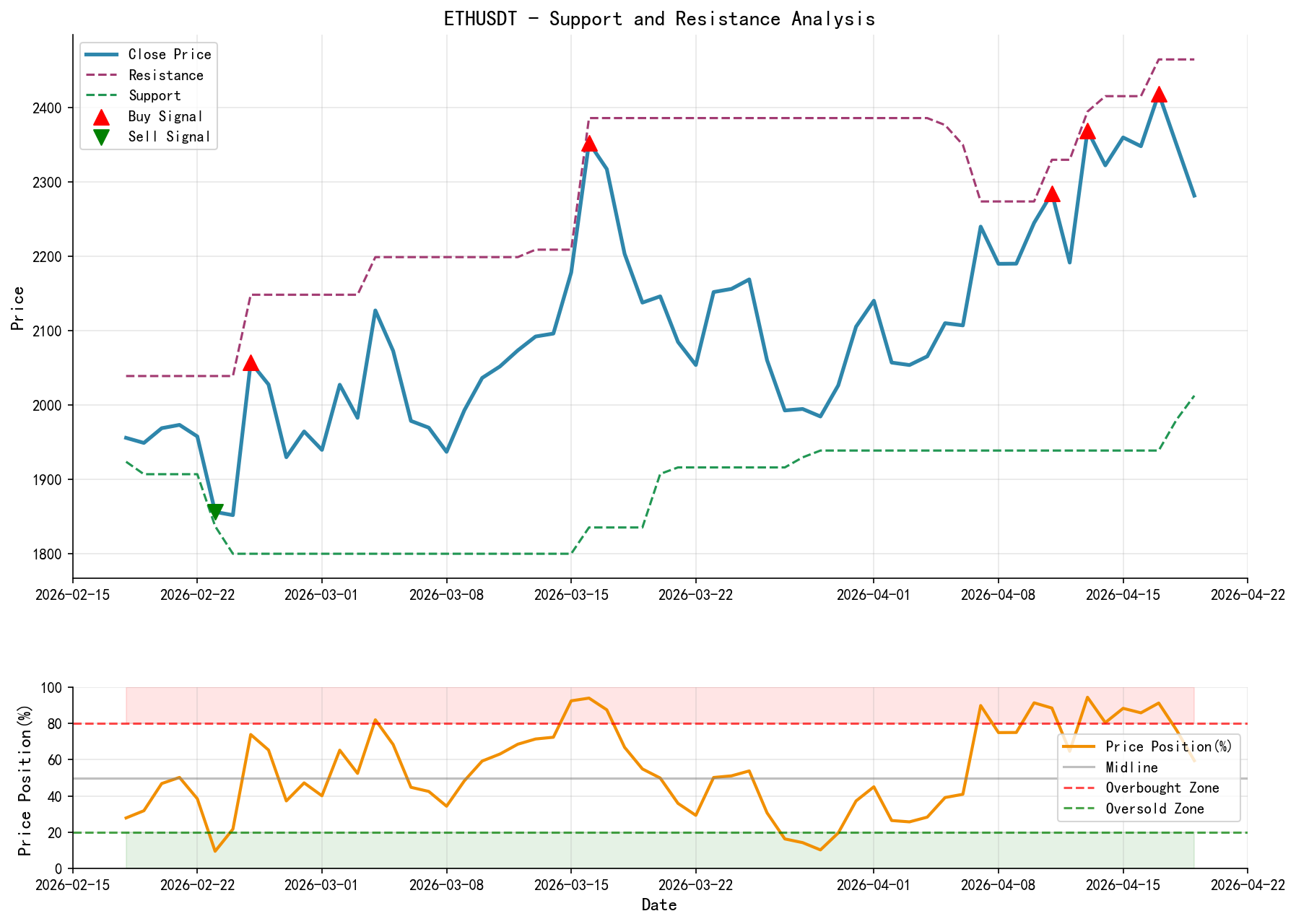
- 1. $2,250 - $2,200: Convergence zone of MA_20D and MA_30D, also the consolidation platform after the early April breakout. Strong Support Zone.
- 2. $2,000 - $1,950: Upper boundary of the previous accumulation zone and multiple tested lows. Ultimate Support Zone; a break below would invalidate the bullish structure.
- • Primary Resistance:
- 1. $2,320 - $2,350: Starting point of the recent pullback and location of MA_5D/10D. Near-term Strong Resistance.
- 2. $2,380 - $2,420: April high zone, Core Resistance Zone. A decisive breakout above this zone would be a strong signal for trend continuation.
- • Primary Support:
- • Integrated Wyckoff Events and Trading Signals:
- • Market Phase Judgment: Pullback testing phase following an uptrend, currently at a critical decision point.
- • Core Trading Logic: Await signals of demand regaining control at support levels.
- • Bullish Scenario and Action Plan:
- • Scenario: Price retraces to the $2,250-$2,200 support zone, followed by diminishing volume (supply exhaustion) or a demand-driven high-volume rebound (e.g., single-day gain >2% and VOLUME_AVG_7D_RATIO >1.2).
- • Action: Consider establishing long positions in phases.
- • Initial Stop Loss: Set below $2,150 (breaking below MA_30D and recent consolidation platform).
- • Target Outlook: Upward towards the $2,380-$2,420 resistance zone; a breakout could target higher levels.
- • Bearish/Watchful Scenario:
- • Scenario: Price rallies to the $2,320-$2,350 resistance zone, exhibiting low volume or high-volume stalling (supply re-emergence).
- • Action: Longs should reduce positions or remain watchful. Aggressive traders might attempt short-term shorts, but caution is advised as this would be counter to the primary trend.
- • Key Risk Point: If price breaks below $2,150 on high volume, it indicates a deepening correction, potentially returning to wide-range consolidation. Long strategies should be paused.
- • Future Validation Points:
- 1. Bullish Validation Point: After stabilization in the support zone, can a "demand-dominated" high-volume bullish candlestick (high volume + strong gain) appear?
- 2. Bearish Validation Point: Does another "supply-dominated" high-volume stalling or declining candlestick appear upon rallying to the resistance zone?
- 3. Structural Breakdown Point: A closing price decisively below $2,000 would disprove the current "healthy correction" hypothesis, potentially leading the market to retest lows.
End of Report
Disclaimer: All conclusions in this report are derived based on the provided historical data and conform to Wyckoff volume-price analysis principles. They do not constitute any investment advice. Markets involve risks; invest cautiously.
Thank you for your attention! Wyckoff volume-price market analysis is published daily before the 8:00 AM market open. Your feedback and shares are sincerely appreciated and crucial. Let's work together to see the market signals clearly.
Member discussion: