Understood. As a quantitative trading researcher proficient in the Wyckoff method, I will draft a comprehensive and in-depth quantitative analysis report based on the provided BTCUSDT data and historical ranking indicators. All conclusions will be strictly derived from the data and conform to Wyckoff's principles of volume and price analysis.
BTCUSDT Quantitative Analysis Report (Based on the Wyckoff Method)
Product Code: BTCUSDT
Analysis Date Range: 2026-02-18 to 2026-04-19
Report Generation Time: 2026-04-20
I. Trend Analysis and Market Phase Identification
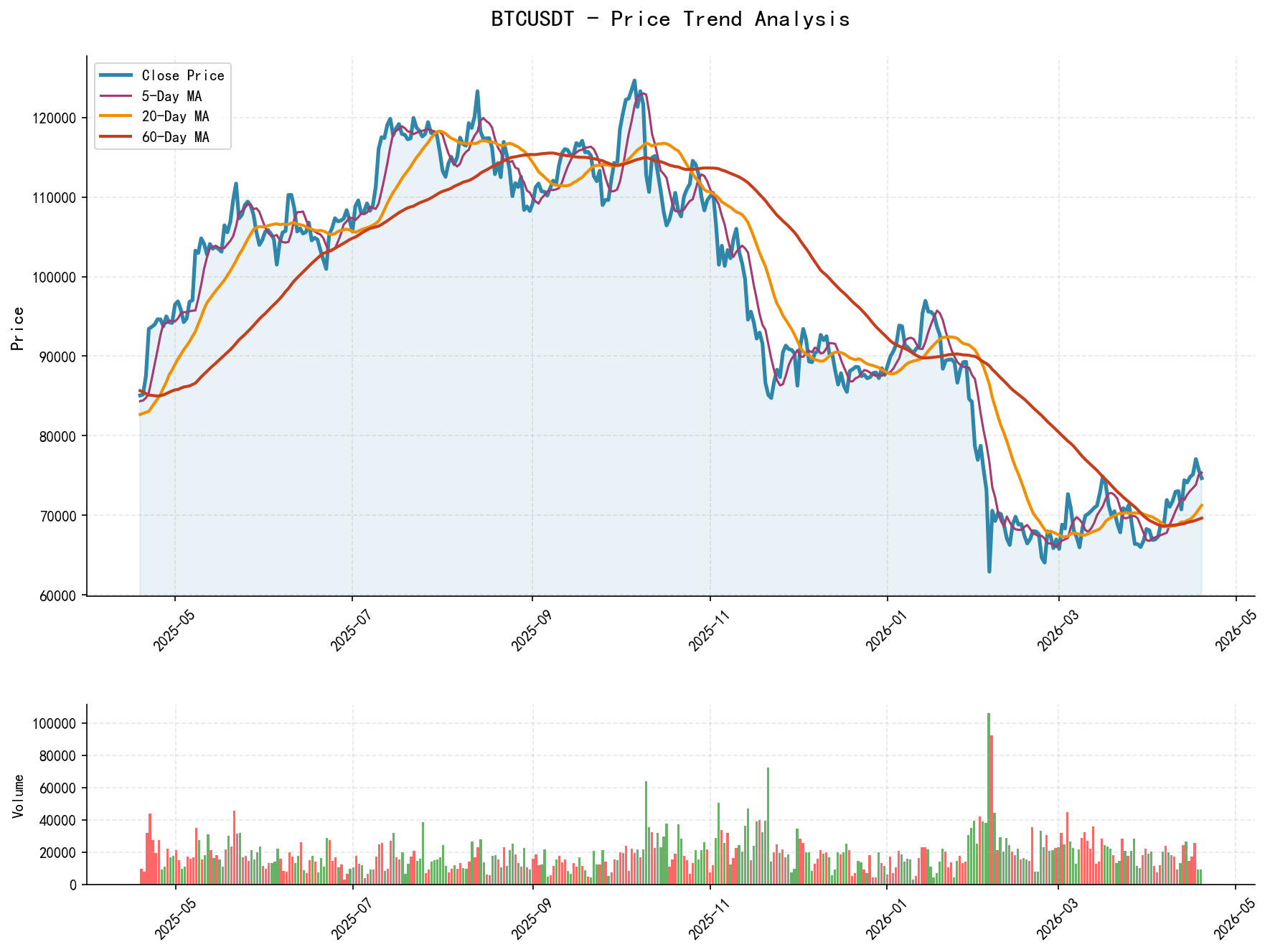
As of 2026-04-19, the subject BTCUSDT had an opening price of 75691.76, a closing price of 74668.00, a 5-day moving average of 75371.92, a 10-day moving average of 73981.24, a 20-day moving average of 71252.84, a daily change of -1.35%, a weekly change of 5.55%, a monthly change of 9.35%, a quarterly change of 9.35%, and a yearly change of -14.81%.
- 1. Moving Average Alignment and Price Relationship:
- • Overall Trend: Throughout the analysis period, the price (
CLOSE) traded below all major medium-to-long-term moving averages (MA_20D,MA_30D,MA_60D) for the majority of the time, displaying a clear bearish alignment pattern (MA_60D>MA_30D>MA_20D>Price). - • Key Change: Starting from 2026-03-04, the price successfully broke through and stabilized above the short-term moving averages
MA_5DandMA_10D. TheMA_5Dbegan to turn upward in early March and crossed above theMA_10Din mid-March, forming a short-term golden cross. However, the price encountered repeated resistance when testing theMA_20DandMA_30D(approximately the 72000-78000 zone), indicating significant pressure from the intermediate-term trend. - • Current Status (2026-04-19): The price (74668) is between
MA_5D(75372) andMA_10D(73981), slightly aboveMA_10D, but remains suppressed byMA_20D(71253) andMA_30D(70425). This suggests the market is at a critical juncture between a short-term rebound encountering resistance and the intermediate-term trend.
- • Overall Trend: Throughout the analysis period, the price (
- 2. Inferred Market Phase (Wyckoff Perspective):
- • Initial Phase (Mid-to-late February): From February 18 to February 23, the price accelerated its decline under strong suppression from the
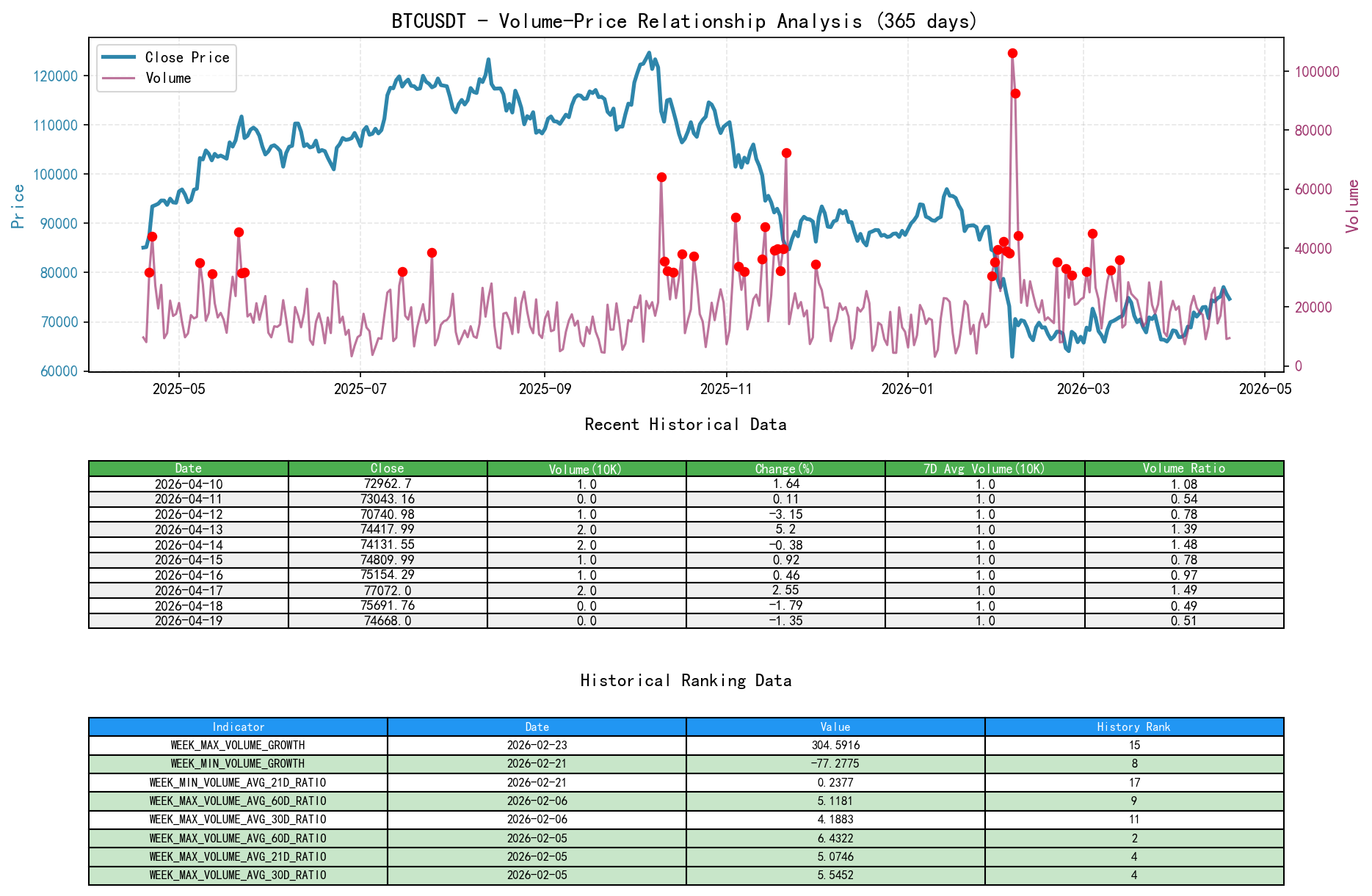
MA_60D. Notably, a high-volume plunge occurred on February 23 (PCT_CHANGE-4.42%,VOLUME_GROWTH304.59%), aligning with the characteristics of Panic Selling or a downside climax in Wyckoff theory, typically signaling the exhaustion of downward momentum. - • Intermediate Phase (March to Mid-April): Following the panic low (around 64000), the market did not immediately experience a V-shaped reversal but entered a period of wide-range consolidation with gradually rising lows. The price tested the 64000-66000 support zone multiple times, accompanied by increased volume (e.g., March 27), followed by orderly rebounds. This aligns with features of the Initial Accumulation or Re-accumulation phase, where large investors absorb supply at lower levels while shaking out weak holders through consolidation.
- • Recent Phase (Mid-to-late April): After rebounding to the 75000-76000 zone (near
MA_30Dresistance), the price has shown low-volume pullbacks and stagnation at higher levels (April 18-19). This hints that the market may be entering a Test or Preparatory Distribution phase, requiring observation of whether supply (selling pressure) re-emerges at key resistance levels.
- • Initial Phase (Mid-to-late February): From February 18 to February 23, the price accelerated its decline under strong suppression from the
II. Volume-Price Relationship and Supply-Demand Dynamics
As of 2026-04-19, the subject BTCUSDT had an opening price of 75691.76, a closing price of 74668.00, volume of 9447.76, a daily change of -1.35%, volume of 9447.76, a 7-day average volume of 18690.37, and a 7-day volume ratio of 0.51.
- 1. Key Day Analysis (Based on Wyckoff Events):
- • Panic Selling Day (2026-02-23):
PCT_CHANGE-4.42%,VOLUME33k (significantly above recent averages),VOLUME_GROWTHas high as 304.59% (ranking 15th highest in the past ~10 years). The price closed near its low. This is a classic supply-dominated plunge, but extreme volume often indicates capitulation, setting the stage for a subsequent rebound. - • Demand Return Day (2026-03-16): The price rose 2.84%, breaking through recent highs, with
VOLUMEat 28.4k,VOLUME_AVG_7D_RATIOat 1.14, andVOLUME_GROWTHat 102.39%. This represents high-volume advance, indicating active demand entry and confirming the breakout attempt from the accumulation range. - • Supply Appearance Day (2026-04-12): The price fell -3.15% after nearing previous highs (73000+), with
VOLUMEat 13.5k andVOLUME_AVG_7D_RATIOat 0.78. Volume did not increase significantly. This is a low-volume pullback, but combined with the location (resistance zone), it suggests temporary demand retreat and slight supply dominance, without panic. - • Stagnation/Hesitation Days (2026-04-18, 19): Two consecutive days of decline (-1.79%, -1.35%) with extremely low volume (
VOLUME_AVG_7D_RATIO0.49, 0.51). This is a low-volume decline, indicating both buyers and sellers are becoming cautious ahead of key resistance, with reduced activity from large investors. The market awaits new directional signals.
- • Panic Selling Day (2026-02-23):
- 2. Quantification of Supply-Demand Forces:
- • Late February: Multiple-period
VOLUME_AVG_*D_RATIOvalues were below 0.5, indicating extremely low market activity and shrinking demand. The extreme volume on the panic day (Feb 23) represented the last concentrated release of supply. - • March Rebound Period:
VOLUME_AVG_7D_RATIOwas frequently greater than 1, especially on key up days (Mar 16, Apr 7, Apr 13), showing demand effectively expanded with price increases, shifting the supply-demand relationship to demand dominance. - • April Highs:
VOLUME_AVG_7D_RATIOfell back to around 0.5, indicating demand could not sustain expansion at resistance levels. Supply and demand entered a weak balance, and upward momentum weakened.
- • Late February: Multiple-period
III. Volatility and Market Sentiment
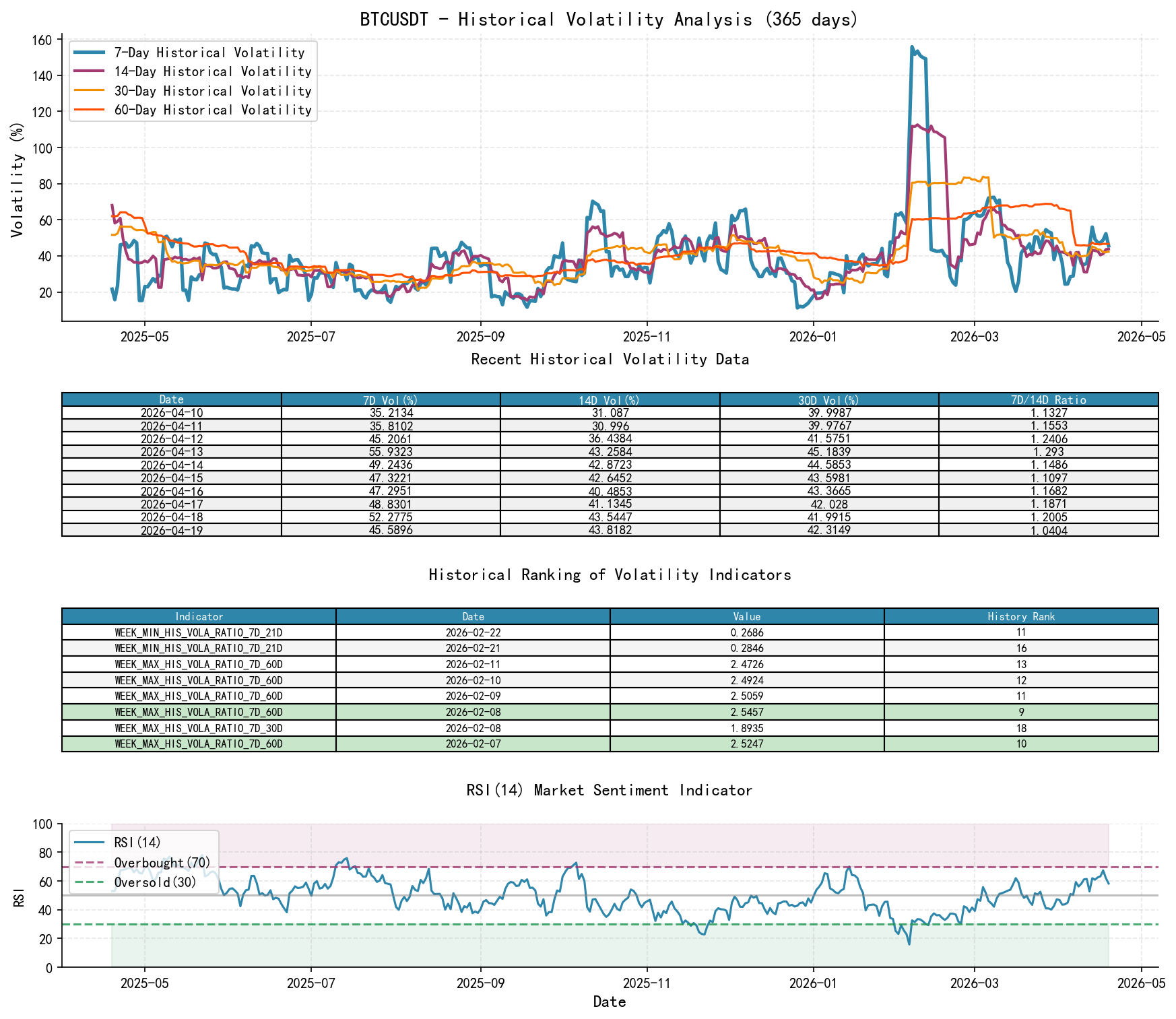
As of 2026-04-19, the subject BTCUSDT had an opening price of 75691.76, a 7-day intraday volatility of 0.40, a 7-day intraday volatility ratio of 0.99, a 7-day historical volatility of 0.46, a 7-day historical volatility ratio of 1.04, and an RSI of 58.29.
- 1. Volatility Level and Changes:
- • February Decline Period:
HIS_VOLA_7DandPARKINSON_VOL_7Dwere at relatively high levels (>0.45), reflecting intense downward volatility. Notably,HIS_VOLA_RATIO_7D_21Ddropped to extremely low levels of 0.28-0.31 on February 21-22 (ranking 11th and 16th lowest in the past ~10 years), indicating short-term volatility was significantly lower than medium-term volatility. This shows market sentiment became extremely suppressed and sluggish after the plunge, a typical manifestation of volatility compression often preceding a trend change. - • March Rebound Period: Short-term volatility (
HIS_VOLA_7D,PARKINSON_VOL_7D) increased moderately, andHIS_VOLA_RATIO_7D_21Drecovered to 0.9-1.4, showing restored market activity and normalized volatility. - • April Consolidation Period: Short-term volatility (especially
PARKINSON_VOL_7D) gradually converged from above 0.45 in late March to around 0.40, withPARKINSON_RATIO_7D_14Dnear 1. This indicates that intraday price fluctuations narrowed ahead of key resistance, and the market entered a watchful phase awaiting directional selection.
- • February Decline Period:
- 2. Overbought/Oversold Status (RSI):
- • February Lows:
RSI_14touched a low of 30.70 (February 24), entering the technical oversold zone, coinciding with the price panic low. - • March-April Rebound:
RSI_14rose to a maximum of 67.40 (April 17), not entering the severe overbought zone (>70), indicating the rally was relatively healthy and did not trigger large-scale profit-taking sentiment. - • Current (April 19):
RSI_14is at 58.29, in a neutral-to-strong region, showing neither overbought pressure nor oversold rebound momentum, consistent with the price consolidating with low volume at higher levels.
- • February Lows:
IV. Relative Strength and Momentum Performance
- 1. Periodic Return Analysis:
- • Long-term Momentum:
YTD(-14.81%) andQTD_RETURN(9.35%) show that despite negative year-to-date returns, significant positive returns have been achieved this quarter, indicating medium-term momentum turned positive starting in March. - • Medium-term Momentum:
MTD_RETURN(9.35% for April) is significantly stronger than March (5.35%), indicating short-term upward momentum continued and strengthened in April. - • Short-term Momentum:
WTD_RETURN(5.55% as of April 19) remains positive but has weakened compared to the previous week (8.98%), confirming the recent slowdown in upward momentum.
- • Long-term Momentum:
- 2. Momentum Conclusion:
The market has moved away from the extreme weakness of February and established clear medium-term upward momentum. However, recent momentum has shown signs of attenuation at key resistance levels. A new catalyst is needed for a breakthrough, or a pullback may be necessary to rebuild momentum.
V. Large Investor ("Smart Money") Behavior Identification
- 1. Accumulation Behavior:
- • Location: The 64,000 - 66,000 USD zone. This area saw multiple high-volume dips (e.g., March 27) without new price lows, followed by orderly rebounds.
- • Intent Inference: Large investors likely conducted strategic accumulation in this zone. They utilized the panic selling in late February and the March consolidation to gather supply at lower costs. The high-volume breakouts on March 16 and April 7 represent demand force following accumulation.
- 2. Distribution/Test Behavior:
- • Location: The 75,000 - 78,000 USD zone (near
MA_30Dand previous highs). - • Recent Performance: The price has shown low-volume stagnation in this zone (April 18-19). Low volume indicates large investors are neither actively buying to push prices higher nor conducting large-scale selling here.
- • Intent Inference: The current behavior leans more towards "testing". Smart money is observing: ① The level of natural selling pressure at the resistance level; ② Whether there is sufficient follow-through demand in the market to absorb this selling pressure and achieve a breakout. Genuine distribution (high-volume stagnation or decline) has not been confirmed by the data.
- • Location: The 75,000 - 78,000 USD zone (near
- 3. Behavior Summary:
The data indicates that large investors completed low-level accumulation in February-March and successfully drove a rebound. Currently, with prices at a key resistance zone, they have shifted to observation and testing, rather than continuing aggressive buying or immediately distributing. The market's next direction will depend on the test results: whether demand overcomes resistance or supply regains dominance.
VI. Support/Resistance Level Analysis and Trading Signals
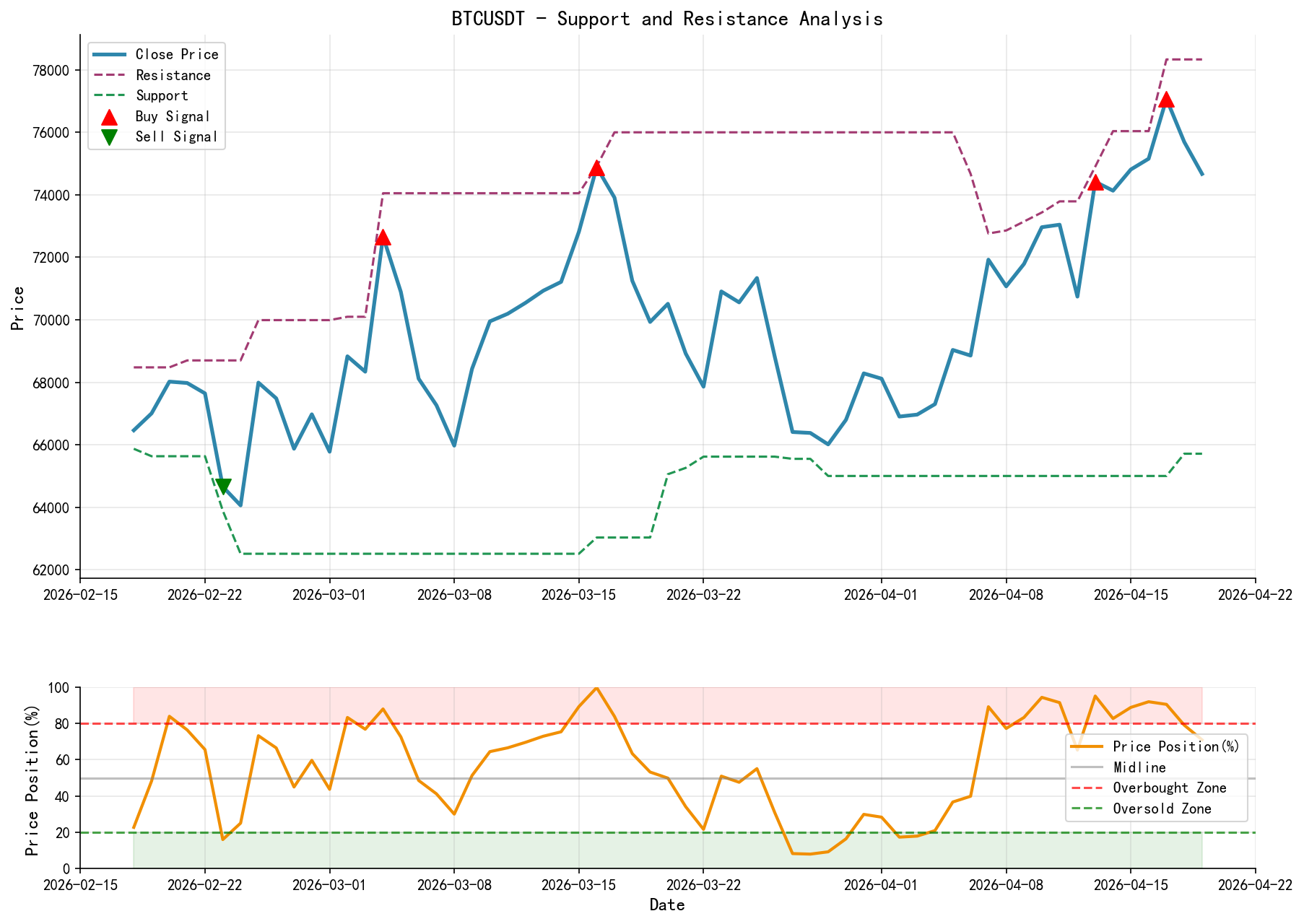
- 1. Key Price Levels:
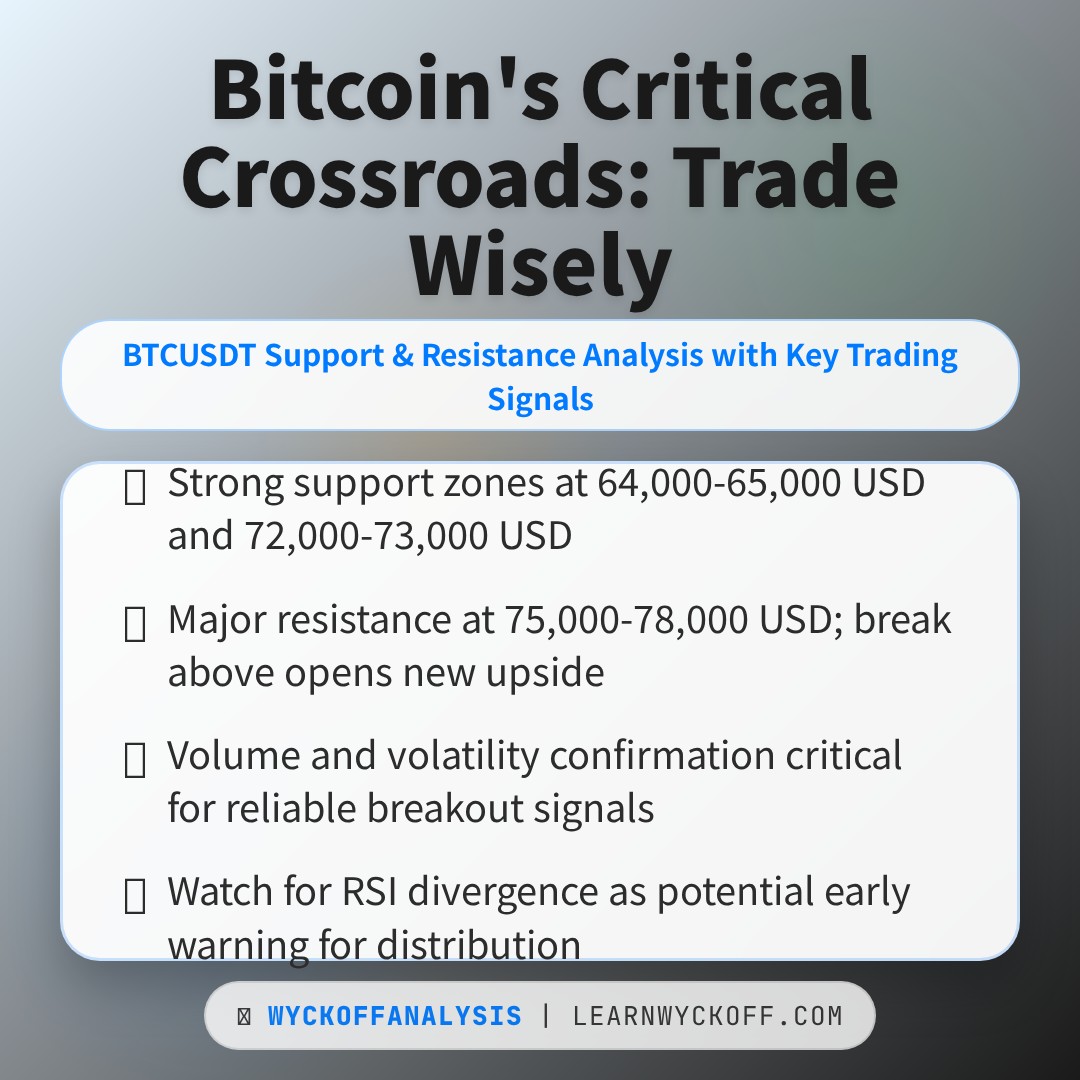
- • Strong Support Zone: 64,000 - 65,000 USD. The panic selling low and starting point for multiple rebounds, serving as the primary accumulation area. A break below this zone would negate the current rebound structure.
- • Secondary Support Zone: 72,000 - 73,000 USD. The lower boundary of the recent consolidation range and near
MA_20D, also the launchpad for the April rally. - • Major Resistance Zone: 75,000 - 78,000 USD. The current price area, encompassing
MA_30Dand the April high. A decisive break above is key to opening new upside. - • Strong Resistance Zone: 78,000 - 84,000 USD. Corresponds to
MA_60Dand the high-level platform preceding the February decline.
- 2. Comprehensive Trading Signals and Operational Recommendations:
- • Market Phase Judgment: The market is in the later stages of the "Initial Accumulation" phase, conducting a test of overhead supply (resistance).
- • Core View: Exercise caution and await test results. The current low-volume consolidation below key resistance is a balance point between bulls and bears, making aggressive operations inadvisable.
- • Bullish Scenario (Demand Prevails):
- • Signal: Price breaks above and stabilizes above 76,000 USD with high volume (
VOLUME_AVG_7D_RATIO> 1.2), especially with a closing price above the April 17 high of 77072. - • Action: Consider initiating a light long position, or wait for a pullback to the 72,000-73,000 support zone for stabilization before going long.
- • Target: Initially target 78,000-80,000.
- • Stop Loss: Below the entry support zone or the 70,000 USD psychological level.
- • Signal: Price breaks above and stabilizes above 76,000 USD with high volume (
- • Bearish/Pullback Scenario (Supply Appears):
- • Signal: Price faces sustained resistance in the 75,000-76,000 zone, followed by a high-volume decline (single-day drop > -2%,
VOLUME_GROWTH> 50%). - • Action: Consider short-term short positions or closing long positions.
- • Target: A pullback test of the 72,000-73,000 or even 68,000-69,000 support levels.
- • Stop Loss: A break above and stabilization above 76,500 USD.
- • Signal: Price faces sustained resistance in the 75,000-76,000 zone, followed by a high-volume decline (single-day drop > -2%,
- • Future Validation Points:
- 1. Volume: Whether high volume aligns with the price direction at key levels (volume expansion on advances, contraction on declines).
- 2. Volatility: If volatility (
PARKINSON_VOL_7D) suddenly expands from its current convergent state, combined with a price breakout, it would enhance signal reliability. - 3. RSI Divergence: Watch for potential bearish divergence on the
RSI_14if the price makes a new high, serving as an early warning for potential distribution.
Disclaimer: This report is derived from quantitative analysis of historical data and is for reference only. Financial markets carry risks, and past performance is not indicative of future results. Any trading decisions should be made independently, incorporating real-time market information.
Thank you for your attention! Wyckoff Volume-Price market analysis is released daily at 8:00 AM before the market opens. Your comments and shares are sincerely appreciated, as your recognition is crucial. Let's work together to see the market signals clearly.
Member discussion: