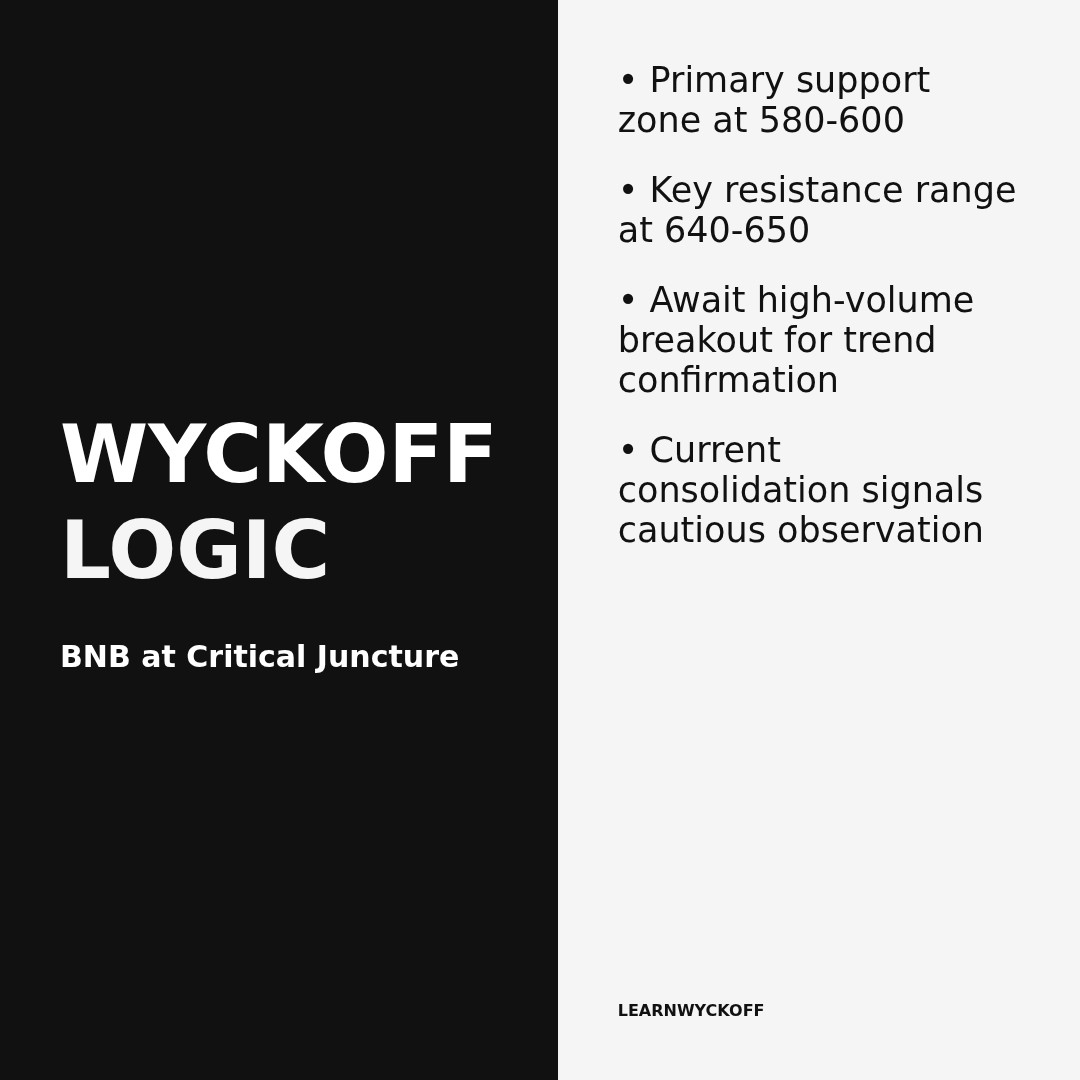
Understood. Following your instructions, I will write a comprehensive and in-depth quantitative analysis report based on the BNBUSDT data you provided, using the Wyckoff Volume-Price Analysis as the core framework.
BNBUSDT Quantitative Analysis Report (Wyckoff Method)
Product Code: BNBUSDT
Analysis Date Range: 2026-02-18 to 2026-04-19
Report Generation Time: 2026-04-20
1. Trend Analysis and Market Phase Identification
As of April 19, 2026, the underlying asset BNBUSDT has an opening price of 629.90, a closing price of 621.09, a 5-day moving average (MA) of 629.03, a 10-day MA of 616.77, a 20-day MA of 609.66, a daily change of -1.40%, a weekly change of 4.88%, a monthly change of 0.59%, a quarterly change of 0.59%, and a yearly change of -28.14%.
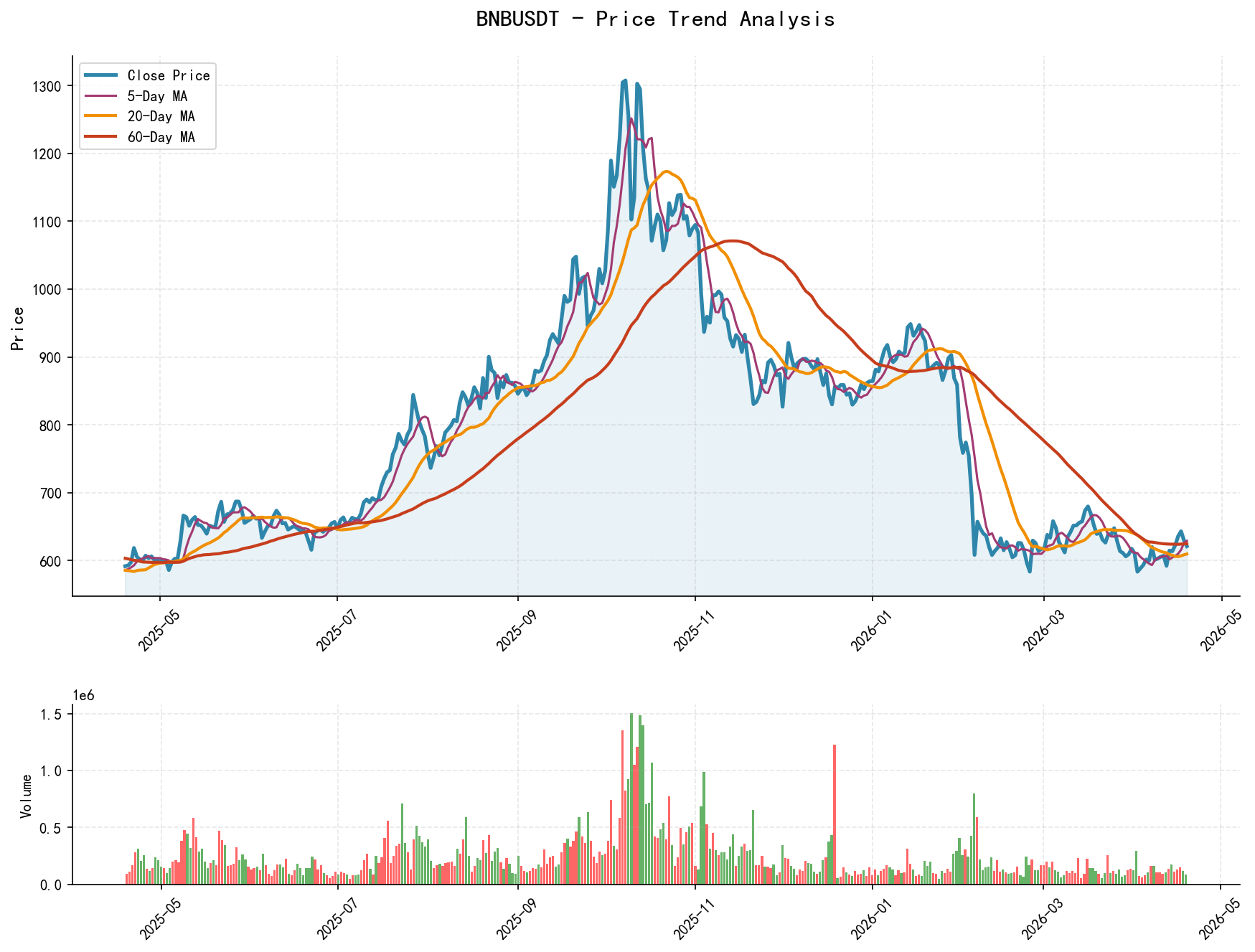
- • MA Alignment and Trend: During the analysis period, the price (CLOSE) has consistently traded below all key moving averages (MA_5D, MA_10D, MA_20D, MA_30D, MA_60D) since late February, forming a typical bearish alignment pattern. This establishes the primary trend as down from the beginning of the analysis period to the present. Notably, the MA_60D (long-term trend) has declined persistently from 819 to 625, and the MA_30D (medium-term trend) has dropped from 751 to 616, with steep slopes indicating strong and sustained downward momentum.
- • MA Crossover Signals: No decisive long-term MA golden crosses occurred during the analysis period. The two price rebounds in early March and early April both failed to decisively break above the MA_30D and quickly fell back upon contact with the MA_30D or MA_60D. This validates the effectiveness of the moving averages as dynamic resistance, classifying the rebounds as technical retracements.
- • Market Phase Inference (Wyckoff Perspective):
- • Selling Climax (Mid-to-late February): From February 18th to 24th, the price plummeted from 604.8 to 583.6. During this period, RSI_14 touched 28.5. Combined with the extreme volume analysis discussed later, this aligns with the characteristics of a Selling Climax (SC).
- • Automatic Rally (AR) and Secondary Test (ST): On February 25th, a massive volume (221k, significantly above average) rebound of 7.85% occurred, which can be viewed as an Automatic Rally (AR). Subsequently, the price fluctuated repeatedly within the 600-630 range and tested the support near 600 multiple times on March 6th, 21st, 27th, and April 2nd, forming a series of Secondary Tests (ST).
- • Current Phase: The price (especially in April) is exhibiting narrow-range consolidation (Trading Range) within the 600-630 band, accompanied by significantly diminished volume (see Section 2) and volatility falling to low levels (see Section 3). This aligns with the initial characteristics of an Accumulation area or a consolidation within a downtrend according to Wyckoff theory. The key is to observe whether a Jump out of the range occurs to the upside, or if a breakdown to the downside follows a Spring or Last Point of Support (LPS). Currently, the price is hovering near the lower boundary of the range, warranting close attention.
2. Volume-Price Relationship and Supply-Demand Dynamics
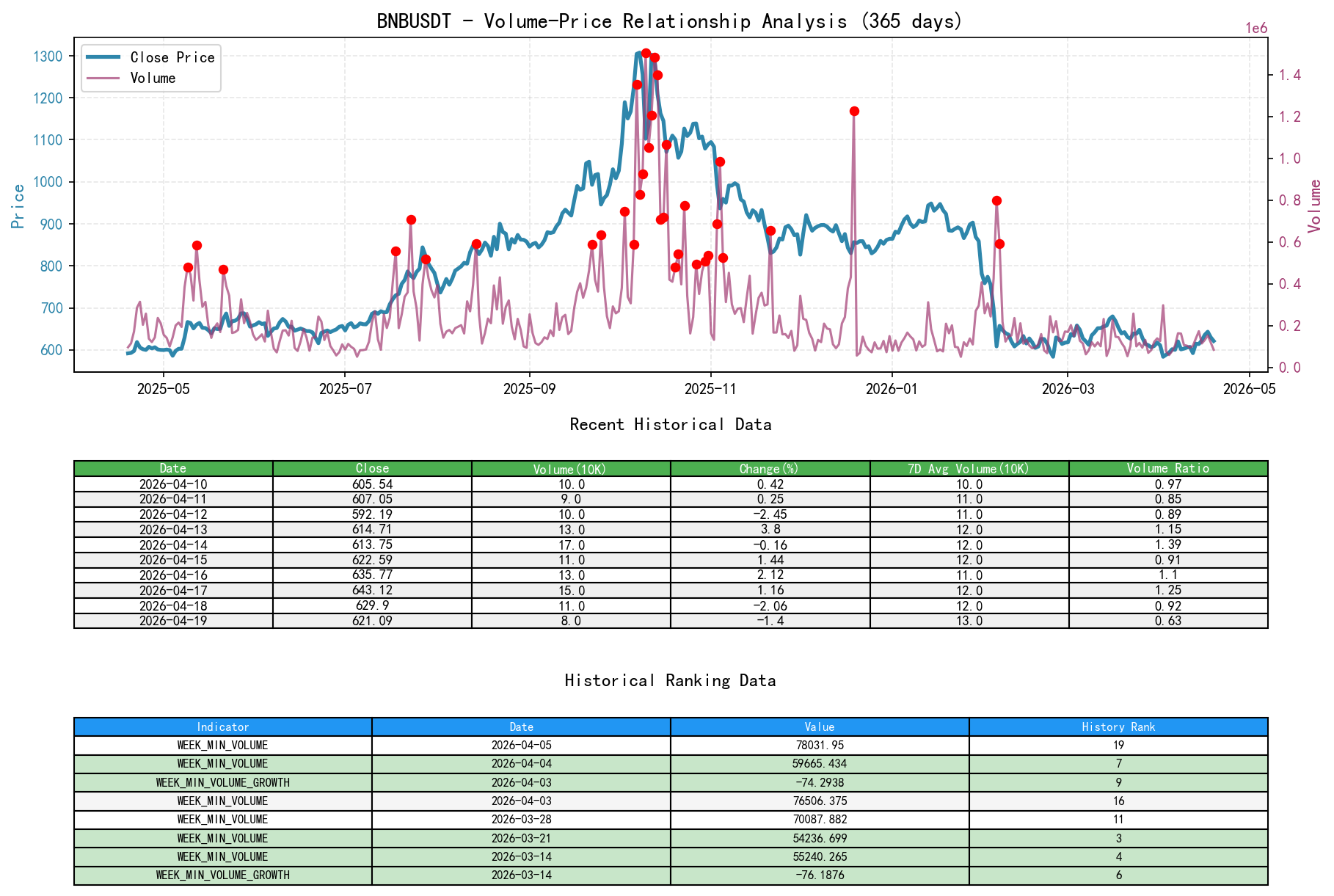
As of April 19, 2026, the underlying asset BNBUSDT has an opening price of 629.90, a closing price of 621.09, a volume of 84810.39, a daily change of -1.40%, a volume of 84810.39, a 7-day average volume of 133614.70, and a 7-day volume ratio of 0.63.
- • Key Day Analysis:
- • Selling Climax (Supply Peak): 2026-02-23 is a classic supply day. The price fell sharply by 2.99%, with volume surging by 257.40% to 245k, resulting in a VOLUME_AVG_7D_RATIO as high as 2.40. This indicates a significant presence of supply (selling pressure) accompanying the decline, characteristic of panic selling. Historical ranking data shows the volume increase (257.4%) on that day ranks 19th in the past decade, confirming the extremity of the event.
- • Automatic Rally (Demand Attempt): On 2026-02-25, the price surged 7.85% with a volume of 221k (VOLUME_AVG_7D_RATIO=1.67), indicating a strong attempt by demand to enter the market and absorb the panic selling.
- • Signs of Distribution/Supply Re-emergence: On 2026-04-02, the price fell 4.47% with a volume of 298k (VOLUME_AVG_7D_RATIO=2.71, VOLUME_AVG_14D_RATIO=2.58). This represents another significant instance of "high-volume decline," suggesting concentrated supply re-emerged near the 600 level, thwarting the price rebound.
- • Low-Demand Rallies: The rallies in mid-March (March 13-16) and mid-April (April 13-17) saw price increases but with volume significantly lower compared to the panic days (VOLUME_AVG_7D_RATIO mostly below 1.3). This indicates a lack of sustained follow-through demand, representing No Demand Rallies, which typically signal unsustainable rebounds.
- • Overall Volume Characteristics: Entering April, market volume has shown systematic contraction. Multiple indicators, including VOLUME_AVG_14D, 21D, 30D, and 60D, repeatedly reached historically low rankings in early April (e.g., the 60-day average volume ranked 1st lowest on April 15th, and the 14-day average volume ranked 13th lowest on April 7th). This suggests overall market participation has reached an extreme low, with both buyers and sellers in a state of观望. According to Wyckoff principles, diminished volume (volume dry-up) appearing at the end of a downtrend often signals exhaustion of downward momentum, but a rise requires confirmation by increased volume.
3. Volatility and Market Sentiment
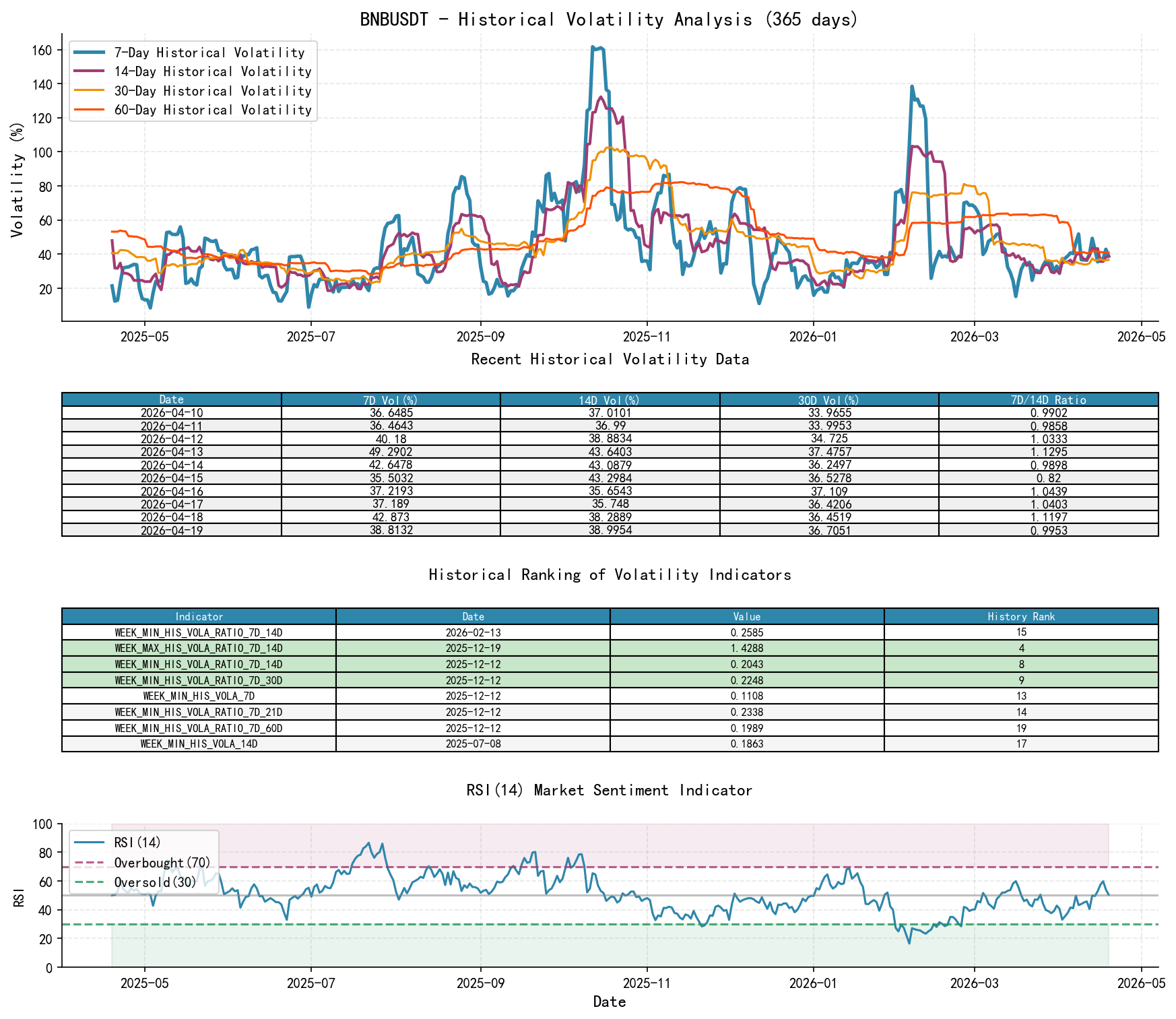
As of April 19, 2026, the underlying asset BNBUSDT has an opening price of 629.90, a 7-day Parkinson Volatility of 0.35, a 7-day Parkinson Volatility Ratio of 1.01, a 7-day Historical Volatility of 0.39, a 7-day Historical Volatility Ratio of 1.00, and an RSI of 50.58.
- • Volatility Levels and Changes:
- • From late February to early March, both HIS_VOLA_7D and PARKINSON_VOL_7D were at high levels (near 0.7 and 0.52, respectively), aligning with the price crash and market panic.
- • Entering April, volatility declined systematically. By April 19th, HIS_VOLA_7D=0.388 and PARKINSON_VOL_7D=0.349, both retreating to relatively moderate levels. PARKINSON_RATIO_7D_60D=0.887 indicates that short-term volatility has fallen below the long-term average, signaling a market transition from "panic" to "dullness" or "hesitation."
- • Sentiment Indicator (RSI): The RSI_14 touched or fell below the 30 oversold line multiple times during the analysis period (28.5 on Feb 24, 43.6 on Mar 21, 33.1 on Apr 2), confirming pessimistic market sentiment. Recently, the RSI has oscillated in the 40-55 range, moving away from extreme oversold conditions but not entering the strong zone (>70). Sentiment remains neutral-to-weak, consistent with the price consolidation pattern.
4. Relative Strength and Momentum Performance
- • Periodic Return Analysis:
- • Short-term (WTD): Exhibits high volatility, reflecting the characteristics of a ranging market. The most recent weekly return (as of Apr 19) is +4.88%, showing weak rebound momentum in the very short term.
- • Medium-term (MTD/QTD): The return for April-to-date (MTD) is only +0.59%, and the Q1 (QTD) return is -1.07%, indicating extremely weak medium-term momentum, with the market essentially stagnant.
- • Long-term (YTD): The year-to-date return is -28.14%, while the TTM_12 (Trailing Twelve Months) return is +4.96%. This stark contrast reveals that despite recent consolidation signs, BNB remains in a deep correction over a longer time horizon, with significantly negative long-term momentum.
- • Momentum Conclusion: BNB's short-term momentum is weaker than its medium-term momentum, and its medium-term momentum is much weaker than its long-term downward momentum. Any rebound lacks sustained, powerful momentum support and can currently only be defined as weak consolidation within a long-term downtrend.
5. Large Investor ("Smart Money") Behavior Identification
- • Accumulation Behavior Inference: The massive volume during the Selling Climax (SC) on February 23rd and the secondary supply on April 2nd indicates significant share exchange at panic price levels. Considering the absence of a subsequent sustained crash and the price finding repeated support near 600, it can be inferred that large capital undertook accumulation (buying) in the panic zone below $600.
- • Distribution/Supply Control Behavior Inference: At local highs on March 16th (679.71) and April 17th (643.12), the price stalled and retreated without significant volume expansion. This suggests that supply (selling pressure) remains strong in the 640-680 range, possibly from sell-offs by trapped positions seeking to exit or profit-taking by early accumulators. "Smart money" did not strongly push prices higher at these points, potentially still controlling the pace of the rise or engaging in local distribution.
- • Current Intent: Synthesizing volume-price data and volatility, large investors appear to be leveraging the low-volatility, low-volume market environment to conduct selective accumulation below 600 and supply control above 640-650, suppressing the price within a relatively narrow range to facilitate筹码 redistribution. Their behavior aligns more with the characteristics of accumulation within a trading range rather than an immediate launch of an uptrend.
6. Support/Resistance Level Analysis and Trading Signals
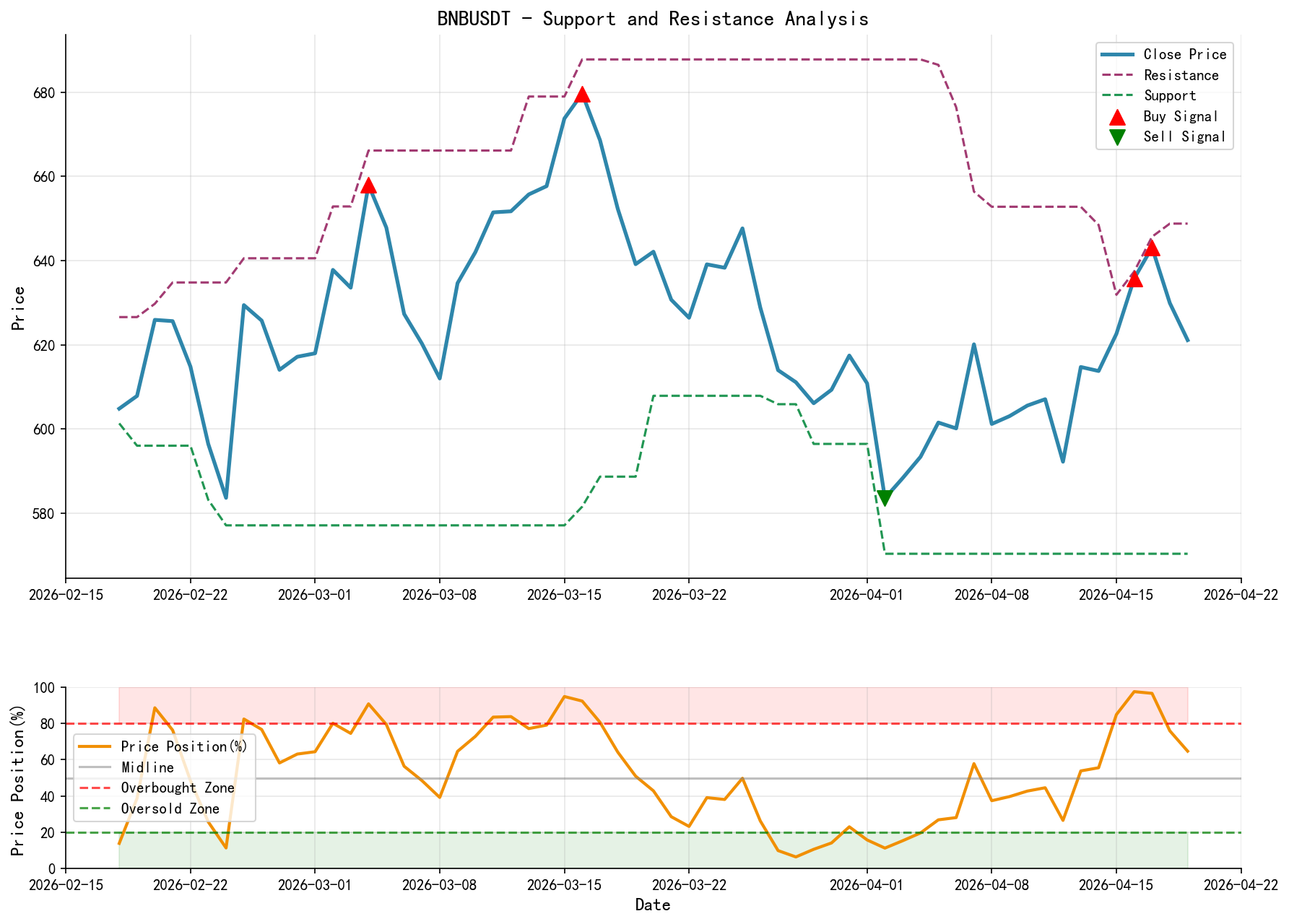
- • Key Support Levels:
- • S1: 580-600 Range: This is the dense成交区 and psychological barrier formed by multiple panic sell-offs and tests in February, March, and April. It is the primary support. A breakdown below this area could open new downside territory.
- • S2: 570: The low point of the April 2nd crash, acting as secondary support.
- • Key Resistance Levels:
- • R1: 640-650 Range: The peak area of rebounds in late March and mid-April, also the current location of the MA_30D. This is the primary resistance.
- • R2: 675-680 Range: The peak of the mid-March rebound, near the MA_60D, constituting strong resistance.
- • Comprehensive Wyckoff Trading Signals:
- • Current Signal: Observe/Wait for Clearer Signals. The market is in a narrow-range consolidation phase at the tail end of a downtrend, with volatility and volume at lows. "Smart money" behavior indicates range-bound operations. Patience is advised, awaiting a market direction decision.
- • Bullish Scenario and Operational Suggestions:
- • Scenario: The price finds strong support in the 580-600 support zone, followed by high-volume上涨 (VOLUME_AVG_7D_RATIO > 1.5) breaking through the 640-650 resistance zone, with the RSI moving back above 50.
- • Signal: This would signal demand regaining control of the market and a potential exit from the accumulation range.
- • Suggestion: Consider a light long position trial after a confirmed high-volume breakout above 650, setting a stop-loss below the low of the breakout candle or the 600整数关口.
- • Bearish Scenario and Operational Suggestions:
- • Scenario: The price rebounds to the 640-650 resistance zone and again shows high-volume stalling/decline, or eventually breaks below the 580 support in a decline on low volume.
- • Signal: The former signals supply reasserting dominance; the latter signals support failure and downtrend continuation.
- • Suggestion: Consider shorting near highs if bearish candlestick patterns (e.g., long upper shadows) accompanied by increased volume appear in the resistance zone, with a stop-loss set above the recent high. If a breakdown below 580 is confirmed, additional short positions could be considered, targeting the previous low of 570 and below.
- • Future Validation Points:
- 1. Demand Validation: When the price retests 600 or even 590, observe whether low-volume stabilization (supply exhaustion) or high-volume反弹 (demand entry) occurs.
- 2. Supply Validation: When the price rebounds to 640-650, observe whether volume can expand continuously to drive a breakout or if high-volume stalling reappears.
- 3. Breakout Validation: Whether breaking out above 650 or breaking down below 580, confirmation requires significantly increased volume (VOLUME_GROWTH > 50%) to validate the breakout's effectiveness.
Disclaimer: This report is based on historical data analysis and does not constitute any investment advice. The cryptocurrency market carries extremely high risks with剧烈 price fluctuations. Investors should make independent judgments and bear all risks.
Thank you for your attention! Daily Wyckoff Volume-Price Market Interpretation is released punctually before the 8:00 AM market open. Your comments and shares are greatly appreciated, as your recognition is crucial. Let's work together to see the market signals clearly.
Member discussion: